
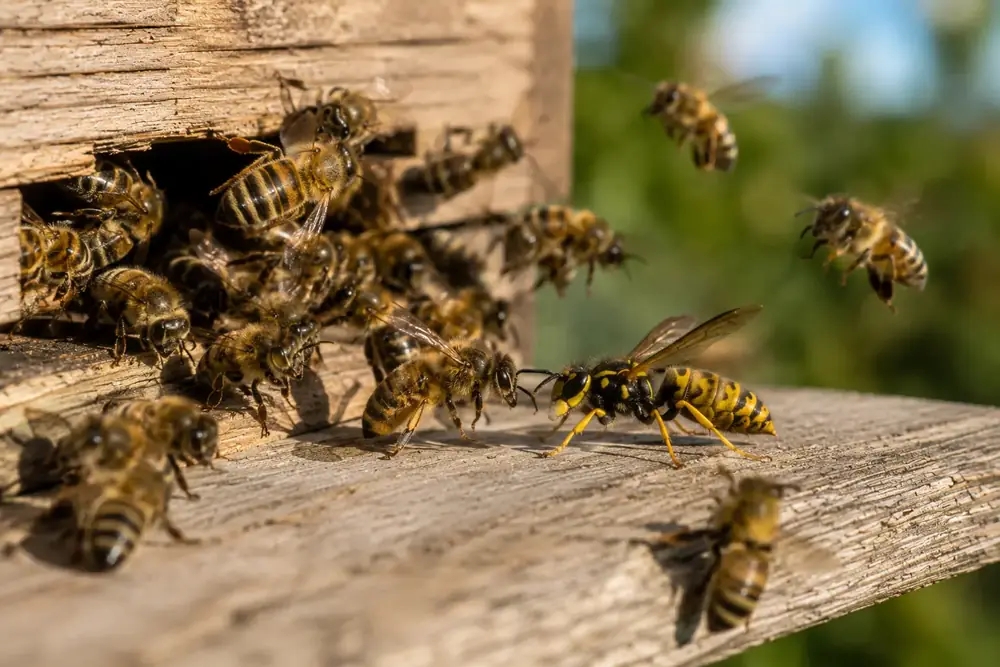
Bee control in Rosebank depends on whether you have a passing swarm or an established hive. Swarms often move on within a day or two; hives in walls, roofs or old trees need removing properly. Where possible we refer or handle the job with a beekeeper so the bees are relocated, and treat only where there is no safe alternative.
Why bees choose Rosebank properties
Bees need two things: forage and a dry, sheltered cavity. The suburbs around Rosebank have both in abundance. The flowering trees, shrubs and gardens of Hyde Park, Houghton, Saxonwold and Parkview keep foraging bees busy for much of the year. And the older houses have the cavities: hollow walls, gaps under roof tiles, old chimneys, boxed-in eaves, disused meter and water boxes, compost bins and the hollow trunks of old trees.
Swarming peaks in spring and early summer, when strong colonies split and part of the colony leaves with the old queen to find a new home. That is when we get the most calls about clusters of bees hanging from branches, gates and eaves.
Swarm or hive?
A swarm
A ball of bees hanging on a branch, a fence or an outside wall, often appearing suddenly in the morning. Swarming bees have no home to defend and are usually fairly calm. Scout bees are looking for a permanent site, and the swarm often leaves within a day or two. Keep people and pets away and do not spray it.
An established hive
A steady flow of bees in and out of one spot in a wall, roof, chimney or tree, day after day. Inside, the colony is building comb and storing honey. These do not leave on their own, and the longer they stay, the bigger the colony and the comb become.
How we handle bees
- Assessment. We confirm they are bees and not wasps, and work out where the colony is and how big it might be.
- Relocation where possible. For swarms and accessible hives, we refer the job to, or work with, a beekeeper who can collect the bees and give them a new home.
- Removal from structures. For hives in walls, roofs and chimneys, the comb and honey need to come out as well as the bees. Leaving comb behind attracts new swarms, and melting honey can seep into walls and ceilings.
- Treatment as a last resort. Where a colony is in a place that cannot be opened, or poses a real risk to people, we treat it, then advise on removing the comb and sealing the entrance.
- Sealing. Once the colony is gone, the entrance must be sealed, or the scent of the old hive draws the next swarm to the same spot.
Safety first
African honey bees, the bees found across Gauteng, defend their hive vigorously. Mowing near a hive, hammering on the wall it is in, or a dog barking at the entrance can provoke many bees at once. Keep children and pets away from the entrance and avoid working nearby until it has been dealt with. If anyone in the household is allergic to stings, treat it as urgent.
The mistake that costs the most
Sealing the entrance hole with bees still inside. The colony simply finds another way out, often into the house through a light fitting or ceiling gap, and the comb and honey left in the wall start to rot and attract other pests. Get the colony out first, then seal.
A local tip
Check old chimneys and disused water meter boxes in spring. In the older Rosebank suburbs these are two of the most popular sites for new colonies, and a simple wire mesh cover over a chimney you no longer use, or a closed meter box lid, prevents a lot of trouble.
What bee removal costs, and why
The cost depends on whether it is a swarm or an established hive, how accessible the colony is and how much comb needs removing. A swarm hanging on a low branch is often straightforward; a large hive inside a wall cavity or roof, where tiles or boards must be lifted and comb cut out, takes much more work. Our price guide for pest control shows the guide price for bee work. If it is a swarm that only arrived this morning, waiting a day may cost you nothing.
Related pages
Not sure if it is bees or wasps? See our Rosebank wasp nest removal page. Hyde Park gardens are covered on our Hyde Park pest control page. Further south we deal with bee problems in Johannesburg South, and city-wide through bee control in Johannesburg. Other local services are on our Rosebank page.
Behind every bee job is Combat Pest Control's 25 years of experience, SAPCA registration and registration with the Department of Agriculture. We offer service within 24 hours, and where we treat a colony, the treatment carries a 3-month guarantee. Call Jason on 084 200 2700, or WhatsApp us a photo or short video of the bees from a safe distance.
Questions we get asked
How much does bee removal cost?
It depends on whether it is a swarm or a hive, how easy it is to reach and how much comb needs removing. A low-hanging swarm is usually simpler than a hive inside a wall or roof.
Will a swarm leave on its own?
Often, yes, within a day or two, once scout bees find a new home. Keep people and pets away and do not spray it. If it is still there after a couple of days, call us.
Do you kill bees?
Only as a last resort. Wherever possible we refer the job to, or work with, a beekeeper so the bees can be relocated.
Why do bees keep coming back to the same wall?
Old comb and the scent of a previous hive attract new swarms. Removing the comb and sealing the entrance properly stops it.
Is honey in my wall a problem?
It can be. Left behind, comb and honey can melt in summer heat, stain ceilings and walls, and attract ants, wax moths and rodents.
What should I do if someone is stung many times?
Move away from the bees, remove the stings by scraping them out, and get medical help immediately, especially if there is any swelling of the face or difficulty breathing.