
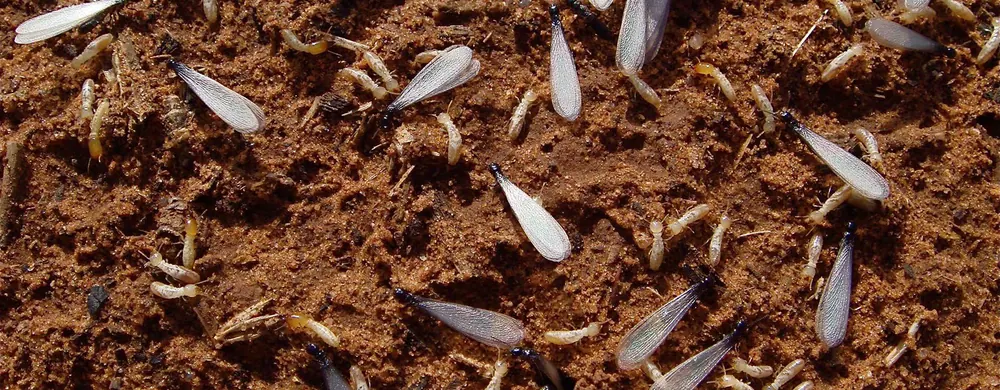
How to get rid of termites depends on which termite you have: harvester termites in the lawn are treated through their nest openings, while subterranean termites in a building need a soil barrier or baiting that reaches the colony underground. This article walks you through identifying the termite, what you can and can't do yourself, and what proper treatment involves.
Step one: don't disturb anything
It sounds backwards, but leave the mud tubes, the damaged timber and the swarm alone for now. Breaking tubes or spraying the termites you can see kills a handful of workers and tells the colony to reroute somewhere you can't see. Those tubes are also the best evidence you have, because they show where the termites are coming from and where they're going. Take photos and wait.
Step two: work out which termite it is
Harvester termites
If you've got bare, sandy patches in the lawn, small round holes with loose soil around them, and short cut pieces of grass lying near the holes, you have harvester termites. They come out to cut grass mostly on overcast days and in the late afternoon, and they're at their worst in dry Highveld winters when lawns are stressed. They don't eat houses.
Subterranean termites
If you've found thin brown mud tunnels running up a wall, a foundation or the back of a cupboard, timber that sounds hollow or crumbles when pressed, bubbling paint along a line, or winged termites coming out of a floor or door frame, you're dealing with subterranean termites. These are the ones that damage buildings. They live in the soil and reach timber through sealed tunnels because they can't survive in dry, open air.
Not sure?
Flying ants emerge on the same warm evenings as flying termites. Ants have a pinched waist and bent antennae; termites have a straight body, straight antennae and four equal wings that snap off. Small round holes and fine dust in timber with no mud tubes usually mean wood borer, not termites. Our termite guide explains the biology in more depth.
What you can do about harvester termites yourself
For a small area of harvester activity, there are products sold for treating the nest openings, applied according to the label when the termites are active. Water the lawn regularly through winter, because harvester termites target dry, stressed grass. Don't re-seed or re-turf before the colony is dealt with; you'll just be feeding them. For larger lawns, sports grounds or estates, professional treatment is more reliable, because every active opening has to be treated for the colony to take the product down.
Why DIY rarely works on subterranean termites
The colony that's eating your door frame isn't in the door frame. It's in the soil, possibly metres away or under the slab, and it may have several routes into the building. Supermarket sprays only touch the workers in the tunnels. Pouring garden chemicals into the soil next to one tube might stop that tube, but the termites simply use another route. Getting rid of them means creating a continuous treated zone in the soil around and under the building, or using a baiting system that workers carry back to the colony. Both need registered products, the right equipment and an understanding of how the building sits on the ground.
What a professional termite treatment involves
- Inspection. We check the foundations, walls, cupboards, roof space, door and window frames, outbuildings and garden, map the activity and confirm the species.
- Finding the entry points. Expansion joints, cracks in the slab, plumbing through the floor, flowerbeds built up against the walls, timber touching soil, and extensions joined to the original house.
- Soil treatment. Registered termiticide is applied to the soil around the building's perimeter, by trenching where there's soil and by drilling through paving or slab and injecting below. Our soil poisoning guide explains how the barrier works.
- Baiting where suitable. Where drilling and trenching aren't practical, bait stations allow workers to carry the active ingredient to the colony.
- Timber advice. Badly damaged timber may need replacing once the colony is controlled.
- Follow-up. Heavy infestations get a return visit to confirm the activity has stopped.
You don't need to move out. The treatment goes into the soil and specific points around the building. Keep children and pets away from the treated zones until they've dried.
Why Johannesburg has so many termites
The Highveld gives subterranean termites an easy life. Deep soils keep moisture below the surface all through the dry winter, and summer storms soak the ground every year. The city's huge tree canopy supplies dead roots and branches, older suburbs have timber floors and built-in cupboards that sit on the slab, and newer developments often have building rubble and timber offcuts buried in the garden. On the West Rand and in the south, where suburbs sit close to ridges and open veld, both harvester and subterranean termites are common. Our page on termite control in Roodepoort covers one of those areas.
The mistakes we see most
- Spraying the swarm. A swarm is a symptom. The colony that produced it is still there.
- Replacing timber first. New skirting boards or door frames installed before treatment are simply the next meal.
- Assuming the original treatment still works. Soil treatments from when the house was built wear down, and paving, extensions and garden beds break the barrier.
- Building flowerbeds against the house. Soil piled above the damp-proof course gives termites a hidden route into the walls.
What termite treatment costs, and why
A harvester termite treatment in an ordinary garden is a much smaller job than treating a house for subterranean termites. For buildings, the cost depends on the length of the perimeter, how much paving or concrete has to be drilled, whether treatment inside the house is needed, how much timber is affected and whether baiting suits the building better than soil treatment. You'll find the guide "from" prices for termite work on our Johannesburg pest control prices page, and we give a firm quote after inspecting. If a small patch of lawn activity is something you can handle with the right product, we'll tell you.
Keeping termites away afterwards
- Keep soil, mulch and paving below the damp-proof course.
- Dig out old stumps and buried timber rather than landscaping over them.
- Store firewood and timber off the ground and away from the walls.
- Fix leaking taps, gutters and irrigation near the foundations.
- Have the treated zone checked after any building, paving or plumbing work.
The guarantee
Our termite treatments carry a 5-year guarantee and a treatment certificate recording what was done. Keep it with your house papers; buyers, banks and conveyancers often ask for proof of termite treatment when a property is sold. For the full service across the city, see termite control in Johannesburg.
Combat Pest Control is owned and run by Jason van Heerden, who has spent 25 years treating termites in Johannesburg homes, gardens and businesses. We're SAPCA registered and registered with the Department of Agriculture under Act 36 of 1947, and we offer service within 24 hours. Found mud tubes or bare patches in the lawn? Call 084 200 2700, or WhatsApp us a photo and we'll tell you which termite it is.

Questions we get asked
What is the best way to get rid of termites?
It depends on the termite. Harvester termites in lawns are treated through their nest openings. Subterranean termites in buildings need a soil barrier or baiting that reaches the colony underground.
How much does it cost to get rid of termites?
A harvester termite treatment in a garden is a modest job. Treating a house for subterranean termites depends on the perimeter, paving, timber damage and method. We quote once we've inspected, and the price guide lists the starting figure.
Can I get rid of termites myself?
Small harvester termite patches in a lawn can sometimes be handled with the right product. Subterranean termites in a building almost always need professional soil treatment or baiting.
How long does termite treatment take to work?
Soil treatments start working as soon as termites contact the treated zone, and activity usually stops within weeks. Baiting takes longer, because the colony has to feed on the bait.
Do I need to leave my house during treatment?
No. Termite treatment is applied to the soil and specific points around the building. Keep children and pets away from treated areas until dry.
Will termites come back after treatment?
Not while the treated zone is intact, and our treatments carry a 5-year guarantee with a certificate. Building work, new paving and flowerbeds can break the barrier, so have it checked after changes.
Should I break the mud tubes?
No. Leave them intact so we can trace the activity to where it's coming from. Breaking them only sends termites along a new, hidden route.
What should I do before you arrive?
Take photos, leave the tubes and damaged timber alone, clear access to cupboards, the garage and the roof hatch, and don't spray anything.