
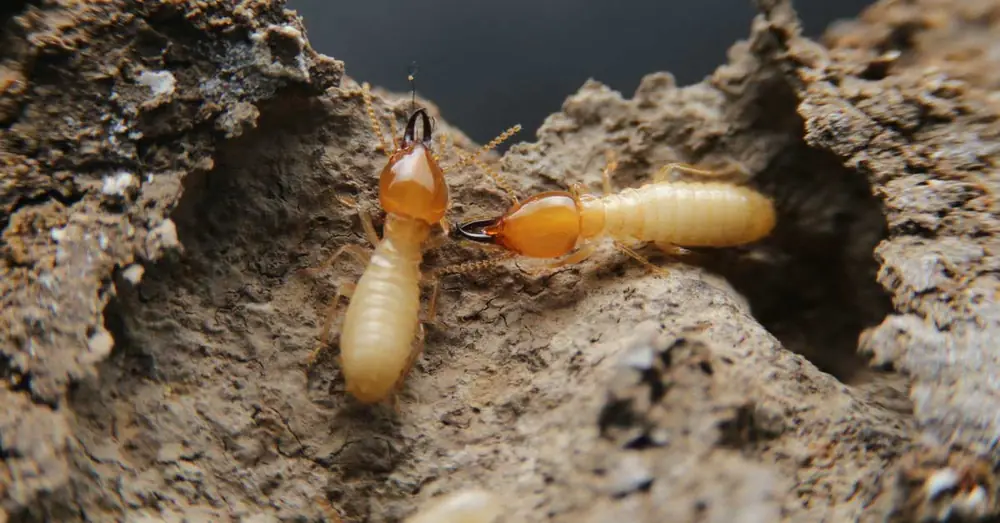
This termite guide covers the two termites that matter on the Highveld: subterranean termites, which eat timber inside buildings, and harvester termites, which strip lawns. Both live in large underground colonies, so the only lasting fix is a registered treatment that reaches the colony, matched to the species, rather than spraying the termites you can see.
How a termite colony is organised
A termite colony is a family run by a king and queen, and the queen can keep laying eggs for years. Almost everything you'll ever see belongs to one of three castes:
- Workers: pale, soft and blind. They do the eating, the building and the feeding of everyone else, and they're the ones in your skirting board.
- Soldiers: workers' guards, with large, darker heads and strong jaws. Break open a mud tube and soldiers rush to the gap.
- Reproductives: the winged termites, or alates, produced once the colony is mature. They leave in a swarm to start new colonies.
Because the workers feed the rest of the colony mouth to mouth, a treatment the workers pick up and carry home can reach the whole nest. That single fact explains most of how termite control works.
The flying swarm after the first rains
On a warm, still evening after the first proper summer storm, mature colonies release thousands of winged termites at once. They flutter towards lights, drop their wings within minutes, and pairs scurry off to find damp soil and a bit of wood to start a new colony. Most get eaten by birds, frogs and geckos. A swarm in the garden simply tells you colonies live nearby, which is true of most Johannesburg properties. A swarm coming out of a wall, a floor or a door frame inside the house is different: it means a colony is already using the building.
Subterranean termites: how they reach your timber
These termites nest in the soil and need constant moisture. Open air dries them out, so they travel inside sealed mud tunnels: thin brown tubes up a foundation wall, across a brick, or behind a cupboard panel. They eat cellulose, which means roof trusses, door frames, skirtings, floorboards, cupboard backs, books, cardboard boxes and the paper face of drywall. They hollow timber out from the inside and leave a thin skin of wood or paint on the surface, so damage is often found only when a thumb goes straight through a door frame. Cracks in a slab, expansion joints, pipes through a floor and soil heaped against a wall all give them a hidden way in.
Harvester termites: the lawn problem
The harvester termite is a grass eater. Dark-bodied foragers come up through small round holes, cut grass into short pieces and carry it underground, usually on cool days in autumn and winter when the Highveld is dry. You'll see loose soil heaps around the holes and patches of lawn turning bare and sandy. They don't damage buildings, and they're treated at the nest openings rather than around the house. Kikuyu lawns on dry, sunny stands suffer most, and a lawn that has been stripped once tends to be hit again the following winter unless the colony is treated. Watering and feeding the grass after treatment helps it grow back over the bare patches before the next dry season.
Termite damage or wood borer?
The two are often confused. Termites leave mud, soil packed into galleries and soft, hollow timber, but no neat holes. Wood borer beetles leave small, round exit holes and fine powdery dust, often on pine floors, roof timbers and old furniture. The treatments are entirely different, and our page on wood borer treatment in Johannesburg covers the beetle side.
Why DIY termite treatment usually fails
Spraying the visible termites kills a handful of workers out of a colony that may number in the hundreds of thousands. Pouring diesel or used oil into holes harms the soil and doesn't reach the nest. Breaking open tubes just makes the colony build a new route, often one you won't see. And a bit of product splashed along one wall leaves gaps the termites walk straight around. Termite control relies on a continuous treated zone or a bait the colony actually accepts, which takes the right product, the right volume and the right equipment.
What professional termite treatment involves
- Inspection: the foundations, walls, roof space, built-in cupboards, door and window frames, garage and garden are checked, the species confirmed and active areas mapped.
- Finding the entry routes: slab cracks, expansion joints, service pipes, wooden steps or posts in soil, and flowerbeds above the damp-proof course.
- Treatment: for subterranean termites, a registered soil treatment applied around and, where needed, under the structure through drilled paving or slab, or a baiting programme where drilling isn't practical. For harvester termites, treatment of the active openings so foragers carry it down.
- Follow-up and paperwork: a return visit where activity was heavy, and a treatment certificate backed by our 5-year termite guarantee.
For new building work, a termite pre-treatment of the soil before the slab is cast is by far the most economical protection, because the treated zone sits exactly where it's needed and can't be reached easily later.
Selling a house? The termite certificate
Buyers and banks often want proof that a property has no active termite infestation. An entomological inspection checks for termites and other wood-destroying insects and results in a certificate or a report of what was found. Book it early in the sale so any treatment needed doesn't delay transfer.
Keeping termites away
- Keep soil, bark mulch and paving below the damp-proof course.
- Remove old stumps, buried offcuts and builder's rubble.
- Store firewood and cardboard off the ground and away from walls.
- Fix leaks and redirect gutters that soak the soil next to the house.
- Re-treat after extensions, new paving or major landscaping, which break the treated zone.
What termite treatment costs, and why
A harvester termite treatment in a normal garden is a small job. Treating an existing house for subterranean termites costs considerably more, and the price rises with the length of the perimeter, the amount of paving or slab to drill, the extent of damaged timber and whether baiting suits the building better. Pre-treatment is priced on the slab area. Our price guide shows where termite work starts, and we quote properly once we've seen the property.
For how this plays out locally, read termite control across Johannesburg or our practical article on getting rid of termites in Johannesburg.
Combat Pest Control is owned and run by Jason van Heerden, a SAPCA member registered with the Department of Agriculture under Act 36, with 25 years of termite work behind him and service within 24 hours. Found a mud tube? Leave it intact, call 084 200 2700, or WhatsApp us a photo first.

Questions we get asked
What does termite treatment cost?
The price is set by the species and the structure. Harvester termites in a lawn are a modest job, while a house with subterranean termites is priced on its perimeter, the drilling needed and the damage found. Pre-treatments are priced on slab area.
Are flying termites a sign my house is infested?
Not if they're in the garden; swarms there are normal after the first rains. Winged termites coming out of a wall, floor or frame inside the house do point to a colony in the building.
How long does a termite treatment protect my house?
A soil treatment protects the treated zone for years, and ours carry a 5-year guarantee with a treatment certificate. Building work and new paving can break that zone, so have it checked afterwards.
Will harvester termites damage my house?
No. Harvester termites eat grass and leave buildings alone. They can still ruin a lawn in a dry winter, so the nest openings are worth treating.
Can I stay at home during termite treatment?
Yes. Termite treatments go into the soil and specific points around the structure. Keep children and pets away from treated soil until it's dry.
Should I break open the mud tubes?
No. Leave them as they are. The tubes show exactly where termites are travelling, which helps us trace the entry point and treat it.
Do new houses need termite protection?
Yes, ideally before the slab is cast. A soil pre-treatment under the foundations and floor is the cheapest and most effective protection a building can get.