
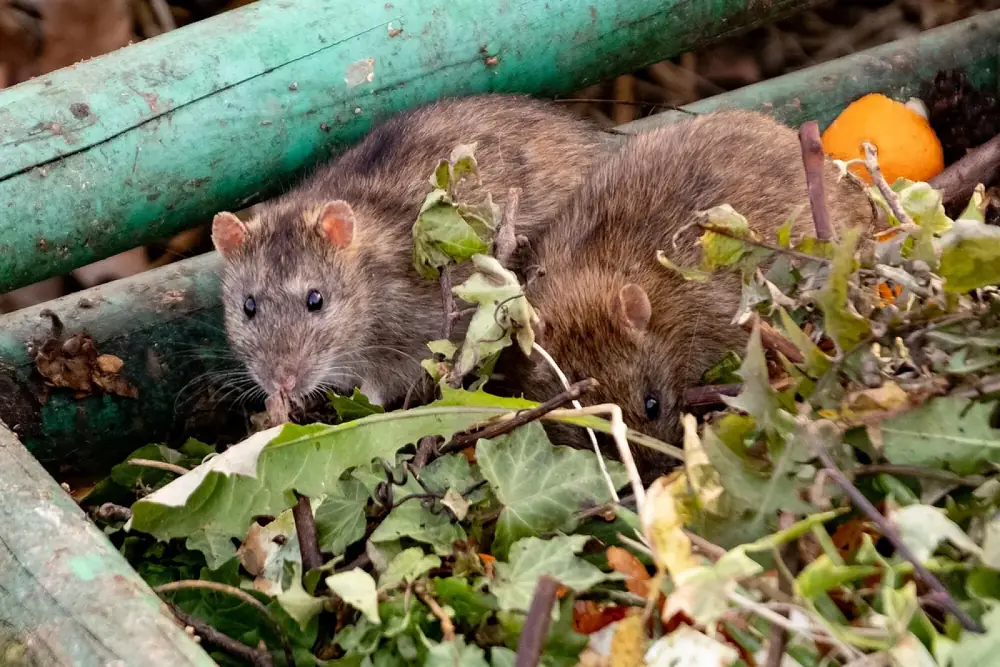
This rat guide is for anyone hearing scratching in the ceiling or finding droppings in the garage. Rats are controlled by finding where they nest and how they get in, then using secure bait stations outside, traps inside the roof and proofing the gaps, so a new family can't move into the same space next winter.
A rat's life in brief
Rats breed quickly. Young rats are independent within weeks and can breed themselves within a few months, and a female can raise several litters a year when food and shelter are good. They live in family groups with a home range they know intimately, travelling the same routes every night and marking them with urine and grease. Anything new on those routes is treated with suspicion, which is the single most important thing to know about controlling them.
Roof rat or brown rat: the body tells you
The roof rat is slender, with a pointed face, big thin ears and a tail longer than its head and body together. Its droppings are spindle-shaped with pointed ends. The brown rat is stocky, with a blunt face, small furry ears and a thick tail that's shorter than its body; its droppings are larger and blunt-ended, like a capsule. Roof rats live high, in ceilings, trees and creepers. Brown rats live low, in burrows, drains and under floors. The species tells us whether to start in the roof or at the drains.
Signs worth checking
- Running, thumping or gnawing in the ceiling, starting soon after the house goes quiet
- A sharp, musty ammonia smell in a cupboard, garage or roof space
- Greasy dark smears along beams, pipes and the tops of walls
- Trampled runways through long grass or along the base of a boundary wall
- Burrow holes under paving slabs, sheds or the compost bin, often with smooth, packed edges
- Fruit hollowed out on the tree, or chewed irrigation drippers and pool cleaner hoses
Our article on spotting rat activity in the roof covers what to listen for and where to look with a torch.
A rat's year on the Highveld
Through summer, rats spread out into gardens, green belts, spruits and veld, where food is everywhere. When the first cold nights arrive in late autumn, they move towards warmth and shelter: ceilings above a geyser, roof spaces over a kitchen, garages full of boxes. That's why rat calls jump sharply from May onwards. Businesses with food waste see rats all year, because their food supply never shrinks.
What rats bring with them
Rats contaminate food and surfaces with urine and droppings, and they can carry diseases such as leptospirosis and salmonella. Their fleas and mites move into the house when a rat dies or leaves a nest. Constant gnawing damages cables, geyser insulation, ceiling boards and plastic pipes, and chewed wiring is a known cause of electrical faults.
Why rats avoid your trap
Put a trap down in the middle of a garage floor and a rat will walk around it for days. Rats prefer to travel along edges, so traps and stations must sit tight against walls and on known runs. Experienced controllers will sometimes leave stations unset or unbaited for a short while so the rats get used to them first. Changing positions every day, as many people do out of frustration, simply resets the rats' suspicion.
Why DIY rat control often fails
- Loose poison in the roof gets carried off and hoarded, so the rats may not eat it, and pets or children can find it.
- Rats that do eat it often die in a wall cavity where they can't be reached.
- One trap for a family of rats catches one rat, and the rest learn from it.
- Nobody closes the gap, so new rats move in after the old ones are gone.
How we deal with rats
We inspect the roof space, the outside walls, the drains and the garden to find nests, runs and entry points. Lockable, tamper-resistant bait stations go outside along the routes, fixed in place so they can't be dragged off. Inside the roof and in food areas we use traps. Follow-up visits check consumption, remove carcasses we can reach and adjust placement. Then we walk you through the proofing. Restaurants, warehouses and estates can move onto a monitoring contract with recorded station checks.
A rat-proofing checklist
- Trim branches back at least a metre from the roofline.
- Replace broken air bricks with sound ones or cover them with steel mesh.
- Seal gaps around pipes and cables where they enter the roof or walls, using cement or mesh rather than foam alone.
- Fit brushes to garage and back doors.
- Keep drain and manhole covers intact and firmly seated.
- Move compost bins, wood piles and pet food away from the house.
What rat control costs, and why
The cost comes down to how many stations and traps the property needs, whether the roof has to be treated, how long the activity takes to clear and whether you want help with proofing. A house with rats in one section of the ceiling is a straightforward job. A complex or a food business is quoted for the site and the service frequency. You'll find guide prices on our prices page. And if it's one rat that wandered in through an open door, a good trap might be all you need.
Not sure if it's rats at all? Our mouse guide covers the smaller intruder. For local work, see rat control in Johannesburg or rat control in Soweto, where dense housing and shared walls bring their own challenges.
Jason van Heerden has run Combat Pest Control for 25 years; the company is SAPCA registered, holds Department of Agriculture registration under Act 36, offers service within 24 hours and backs rat treatments with a 3-month guarantee. Phone 084 200 2700, or WhatsApp a photo of the droppings and we'll confirm what's in your roof.

Questions we get asked
What does rat control cost?
It depends on the number of stations and traps, roof access and how many follow-up visits are needed. A single house is a modest job; complexes and food businesses are quoted per site.
How many rats are there if I've seen one?
Usually more than one. Rats live in family groups, so a rat seen in daylight often means the colony is large or short of food.
Why won't the rats go into my trap?
Because rats are wary of new objects. Place traps tight against walls on their routes, leave them in one spot, and give the rats a few days to get used to them.
Is rat poison dangerous for my dog?
Loose poison is, which is why we use lockable stations that a dog can't open. If you think your dog has eaten rat bait, take it to a vet immediately with the packaging.
How quickly will the rats be gone?
Activity in most homes drops within one to two weeks. Sites with nearby food or cover, such as spruits or busy restaurants, take longer.
Do I need to leave the house during rat treatment?
No. Rodent work uses bait stations and traps, not sprays, so you carry on as normal.
What attracts rats to a property?
Food, water and shelter. Compost, pet food, fallen fruit, bird seed, dripping taps, wood piles and thick creepers are the usual draws.