
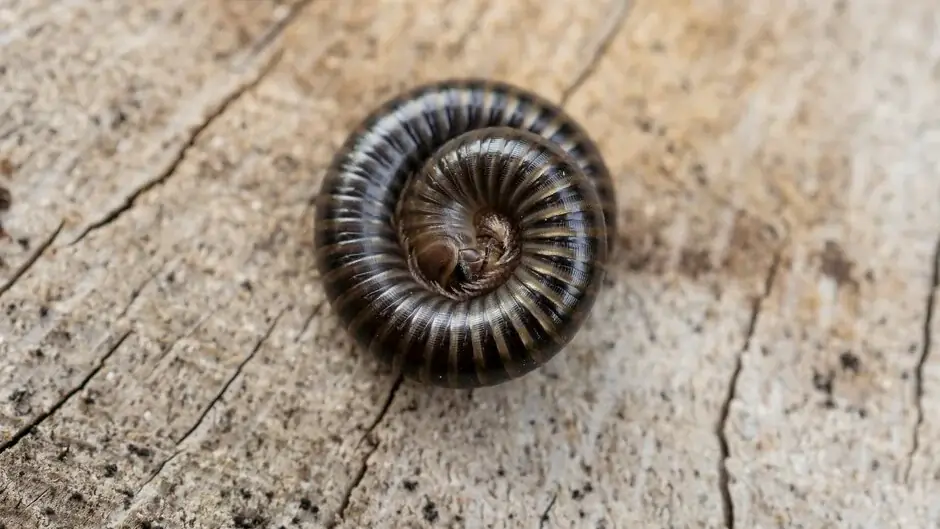
This millipede guide explains why shongololos suddenly appear in their hundreds after summer rain, crawling up walls and into houses. Millipedes are harmless decomposers but can stain skin and leave a smell when crushed. Millipede control means removing the damp leaf litter they live in and treating a barrier around the building's base.
What millipedes are
Millipedes are not insects but arthropods with long, segmented bodies and two pairs of legs on most segments. They move slowly, gliding along on waves of tiny legs, and curl into a tight spiral when disturbed. They eat decaying leaves, rotting wood, compost and other dead plant material, which makes them valuable in the garden, breaking down organic matter and returning it to the soil.
The big, glossy black or dark brown shongololos that children pick up are the most familiar. Smaller millipedes, brown, grey or reddish and only a few centimetres long, are often the ones that invade homes in large numbers.
Why they invade
Millipedes live in damp soil, leaf litter, mulch and under logs and stones. Their numbers build up in gardens with thick mulch, heavy irrigation and lots of decaying plant matter. Then the weather triggers a mass movement:
- Heavy summer storms saturate the soil and flood their shelters, so they climb out and move to higher ground.
- Dry spells after rain send them looking for moisture, which often leads them under doors and into cool, damp rooms.
- Some species simply wander in large numbers at certain times of year, often in early summer.
Once indoors, millipedes usually die within a day or two, because a house is too dry for them. That's why people find them curled up and dead on floors, in corners and in the bath.
Are millipedes harmful?
Millipedes don't bite or sting. Their defence is a fluid released from small glands along the body when they're handled or crushed. In some species it smells unpleasant and can stain skin and floors brown or orange. It can irritate the skin and is painful if it gets into the eyes, so wash your hands after handling millipedes and don't rub your eyes. Dogs that mouth a millipede often drool and foam afterwards; rinse the mouth with water, and speak to a vet if the dog seems unwell.
In the garden, millipedes occasionally nibble seedlings, strawberries and soft fruit lying on damp soil, but the damage is usually minor.
Why sweeping them up doesn't solve it
You can sweep up a bucket of millipedes every morning and there'll be another one tomorrow, because the population living in the garden keeps moving towards the house. Spraying inside does little; the millipedes are already dying. The answer is at the base of the walls and in the beds where they breed.
What we do about millipedes
We inspect the garden and the outside of the building to find where millipedes are breeding and how they're getting in. A residual barrier treatment goes around the base of the outside walls, door thresholds, weep holes, airbricks and garage doors, and into the mulched beds and damp areas next to the house. Inside, we treat entry points where millipedes are coming in. During a wet summer, a follow-up visit may be needed to keep the barrier effective. You don't need to leave home, and children and pets should stay off treated areas until they're dry.
Garden changes that keep numbers down
- Pull mulch, bark chips and leaf litter back from the walls of the house.
- Rake up fallen leaves near the building rather than letting them pile up.
- Move compost heaps, wood piles and stacked logs away from the house.
- Set irrigation timers so beds next to the house don't stay soggy, and water early in the day.
- Clear blocked gutters and downpipes that soak the soil at the foundation.
- Fit door seals and brushes, and close gaps under garage doors.
Millipedes in estates and complexes
Large, landscaped estates and townhouse complexes with lush communal gardens, deep mulch and automatic irrigation can produce enormous millipede numbers. Treating one unit gives that unit a barrier, but the source is the communal gardens. Body corporates get far better results with a coordinated treatment and some changes to the landscaping and irrigation around buildings.
The mistake that keeps them coming
Heaping fresh mulch right up against the house wall every spring. It looks tidy, holds moisture and creates perfect millipede habitat inches from your doors. Leave a strip of bare soil or gravel next to the walls.
What millipede control costs, and why
The cost depends on the length of the building's perimeter, the size and condition of the garden beds, whether outbuildings and garages are included, and whether a follow-up is needed in a wet season. A suburban house with a moderate invasion is a modest job; a large estate home or a complex costs more. Honestly, if you're seeing a handful of millipedes after storms, the garden changes above and a broom may be all you need. For bigger invasions, our price guide shows where barrier treatments start.
If the creature you've found is flat and fast rather than round and slow, read our centipede guide. For local service, see millipede control in Johannesburg or millipede treatment in Fourways, where landscaped estates near the Jukskei see big summer invasions. Our Fourways pest control page covers other pests in the area.
Combat Pest Control is run by Jason van Heerden, with 25 years in pest control, and is SAPCA registered and registered with the Department of Agriculture under Act 36. Expect service within 24 hours, with a 3-month guarantee on millipede barrier treatments. Call 084 200 2700, or WhatsApp a photo of the invasion.

Questions we get asked
How much does millipede control cost?
It depends on the length of the building's perimeter, the garden beds and whether a follow-up is needed. A suburban house is a modest job; estates and complexes cost more.
Are shongololos poisonous?
They don't bite or sting, but they release a fluid that can stain and irritate skin and hurts if it gets into the eyes. Wash your hands after handling them.
Why are millipedes coming into my house?
Heavy rain floods their shelters in the garden, and they move to higher, drier ground, which often means under your doors.
Will millipedes damage my house?
No. They don't damage structures or furniture. Indoors, they usually die within a day or two because it's too dry.
Is millipede treatment safe for my dog?
Yes, once it's dry. Keep pets away from treated areas until then. It's actually safer than letting your dog mouth millipedes.
How long does a millipede barrier last?
The barrier keeps working for weeks to months, depending on rainfall. Our treatments carry a 3-month guarantee, and garden changes extend the effect.
When is millipede season in Johannesburg?
Mainly in the summer rainfall months, from the first storms in spring through to late summer.