
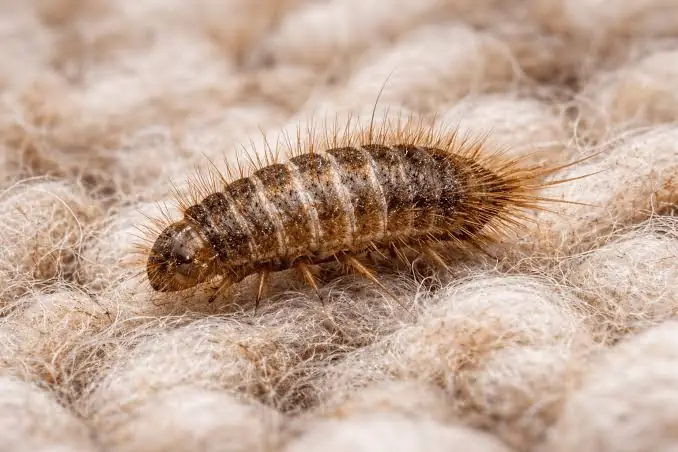
This carpet beetle guide explains the small, hairy larvae behind holes in woollen rugs, jerseys and upholstery. The adult beetles feed on flower pollen and do no harm; their larvae eat wool, fur, feathers, leather and silk in dark, undisturbed places. Control combines finding and removing the infested items with a targeted residual treatment.
The carpet beetle life cycle
Adult carpet beetles are tiny, rounded beetles, a few millimetres long, often with a mottled pattern of white, brown and yellow scales. They fly well and spend much of their adult life outdoors on flowers, feeding on pollen and nectar. Females fly indoors to lay eggs in places that will feed their young: fluff under the skirting, the edge of a carpet, a wardrobe of woollens, an old bird nest in the roof.
The larvae, sometimes called woolly bears, do all the damage. They're small, carrot-shaped and brown, covered in bristly hairs, and they avoid light. Larvae grow slowly, moulting several times and leaving their empty, hairy cast skins behind. Depending on temperature and food, the larval stage can take months, so damage builds unnoticed. In spring and summer, new adults head for the light, and finding them on window sills is often the first sign of a problem.
Carpet beetle or clothes moth?
- Clothes moth larvae spin silky webbing or small tubes on the fabric and leave fine, sandy droppings. You may see small, pale, fluttering moths that avoid light.
- Carpet beetle larvae leave no webbing. Instead you find their hairy cast skins, irregular holes, and bare patches where the pile has been grazed down to the backing.
The treatment approach overlaps, but knowing which you have helps us find the source.
What they eat
Carpet beetle larvae feed on keratin, the protein in animal fibres. That means wool carpets and rugs, woollen jerseys and blankets, felt, fur, feathers in pillows and duvets, silk, leather, and natural-bristle brushes. They also eat pet hair and fluff, dead insects in light fittings and window tracks, dried pet food, and the contents of old bird and rodent nests. Synthetic fabrics are usually safe unless they're soiled or blended with wool.
Where to look
- Under heavy furniture that's rarely moved
- The edges of fitted carpets, especially along skirtings
- Wardrobes and blanket boxes holding winter woollens
- Under rugs and inside the folds of stored curtains
- Light fittings and window tracks full of dead insects
- Roof spaces with old bird nests, a common source in houses with pigeons or sparrows nesting under the eaves
The itchy rash some people get
Some people develop an itchy rash from contact with the tiny hairs on carpet beetle larvae, and it's often mistaken for bites. Carpet beetles don't bite, but if you have unexplained itchy bumps and find larvae or cast skins in your bedding or cupboards, they may be the cause.
Why DIY often doesn't solve it
Spraying the visible holes misses larvae deep in the carpet edge or inside the cupboard. Moth balls in a wardrobe help a little in a sealed space but don't treat the room. Vacuuming the open floor leaves the edges and under-furniture areas where larvae live. And if the source is a bird nest in the roof, adults keep arriving to lay new eggs.
How we deal with carpet beetles
- Inspection: finding active larvae and cast skins, checking stored textiles, carpet edges, cupboards, light fittings and the roof space for nests.
- Removal and cleaning: you sort infested items for washing, dry cleaning, freezing or discarding, and vacuum thoroughly, including edges and under furniture.
- Treatment: a residual, non-staining treatment applied to carpet edges, skirtings, the floors and interiors of cupboards, under furniture and other harbourage.
- Source removal: old nests in the roof cleared, and gaps under the eaves closed if birds are getting in.
Prevention
- Wash or dry clean woollens before storing them for the summer, since larvae are drawn to perspiration and food stains.
- Store clean woollens in sealed bags or plastic boxes.
- Move furniture and vacuum underneath and along carpet edges regularly.
- Clean dead insects out of light fittings and window tracks.
- Keep birds from nesting under eaves and in the roof.
- Check second-hand rugs, furniture and fur items before bringing them inside.
If birds are the source, bird proofing in Johannesburg stops new nests being built in the roof.
The common mistake
Throwing away a damaged jersey and assuming the problem has gone with it. The jersey was the meal, not the colony. Unless the rest of the wardrobe, the carpet edges and any roof nest are dealt with, the next woollen item will be hit.
What carpet beetle treatment costs, and why
Cost depends on how many rooms and cupboards need treatment, how much carpet and stored textile is involved, and whether there's a bird or rodent nest in the roof to clear. A wardrobe and one bedroom is a modest job; a large heritage home full of rugs and antique furniture takes longer. See our pest control guide prices for where treatment starts. A few adults on a window sill in spring don't always mean an infestation, and a good clean may be all you need.
Carpet beetles are often found with fish moths in stored items; see our fish moth guide. For local help, see carpet beetle control in Johannesburg. Older homes in suburbs like Saxonwold, with antique rugs and roof spaces under big trees, are where we often find them.
Combat Pest Control is run by Jason van Heerden, with 25 years of experience, SAPCA registration and Department of Agriculture registration under Act 36. Expect service within 24 hours and a 3-month guarantee on the treatment. Call 084 200 2700, or WhatsApp a photo of the larvae or damage and we'll identify it.

Questions we get asked
How much does carpet beetle treatment cost?
It depends on how many rooms and cupboards are involved, how much carpet and stored textile there is, and whether a roof nest has to be cleared. A bedroom and wardrobe is a modest job.
Do carpet beetles bite?
No. But the hairs on the larvae can cause an itchy rash in some people, which is often mistaken for bites.
How do I know it's carpet beetles and not moths?
Look for hairy brown cast skins and no webbing. Clothes moths leave silky webbing or tubes; carpet beetle larvae don't.
Can I save my damaged rug?
Usually, yes, if the damage is limited. Have it professionally cleaned, treat the room, and check it regularly afterwards.
Is the treatment safe for children and pets?
Yes, once it's dry. Keep children and pets off treated carpets and floors until then. The products we use don't stain.
Do I need to wash everything in the cupboard?
Wash, dry clean or freeze anything made of wool, fur, feathers or silk that has been in an infested cupboard before putting it back.
Where do carpet beetles come from?
Adults fly in from the garden, attracted to flowers, and lay eggs indoors. Old bird nests in the roof are a common source.