
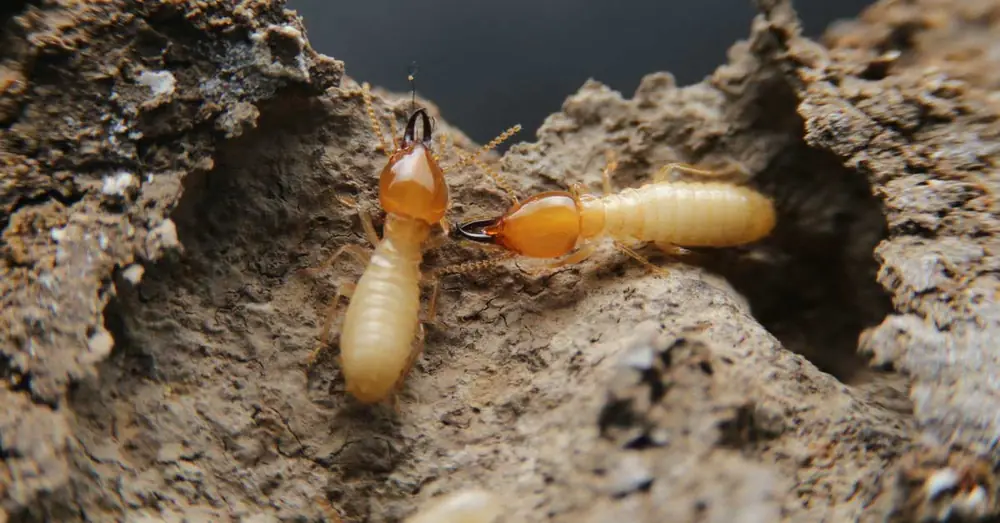
Termite control in Roodepoort starts by working out which termite you have. On the West Rand, harvester termites strip lawns in the dry winter months, while subterranean termites tunnel into skirting boards, door frames and roof timber. We inspect, confirm the species, then treat the colony itself so the damage stops instead of shifting to another spot.
Two very different termite problems
Most Roodepoort termite calls fall into one of two groups, and mixing them up wastes money.
Harvester termites leave your house alone. They come up through small round holes in the lawn, cut grass into short pieces and carry it underground. In winter, when Highveld lawns are dormant and dry, they can clear large patches of kikuyu in a few weeks. You'll see loose soil around the openings, little bundles of cut grass and bare, sandy ground. Many large Roodepoort gardens, especially those with wide sunny lawns, see this every year.
Subterranean termites are the ones that damage buildings. They live in the soil and reach timber through sealed mud tubes, because open air dries them out. They eat skirting boards, door frames, built-in cupboard backs, floorboards and roof trusses, as well as cardboard and paper stored on the floor. Because they work from the inside out, the timber often looks fine until it gives way under a thumb.
Why Roodepoort properties get termites
The climate does a lot of the work. Summer thunderstorms soak the ground from October to March, and the soil stays damp below the surface long after the rain stops. That suits subterranean colonies. The long dry winter, on the other hand, stresses lawns and sends harvester termites foraging harder for grass.
Housing plays its part too. Older homes in areas like Florida were often built with timber floors, wooden window frames and roof trusses that have had decades of exposure. Many have been extended, and the join between old and new foundations is a favourite entry point. In newer complexes around Weltevredenpark and Little Falls, the risk is different: building rubble, offcuts and old tree roots buried during construction give a colony something to eat for years before it finds the units.
Gardens near the ridges and open veld add another factor. Natural ground around the koppies holds established termite colonies, and a property on its edge is simply closer to them.
Signs to check for
- Pencil-thin mud tubes running up foundations, garage walls, the inside of cupboards or along a skirting board
- Timber that sounds hollow or papery when you knock, or paint that bubbles in a line
- Swarms of winged termites emerging indoors from skirting gaps or around a door frame after the first storms
- Small holes with soil heaps and cut grass in the lawn, mostly from late autumn to early spring
- Soil packed into cracks in the slab, expansion joints or around pipes where they enter the house
Flying termites are often confused with flying ants. Termites have straight antennae, a thick waist and four wings of equal length; ants have bent antennae and a narrow waist. If ants are your problem, our ant treatments in Roodepoort are the place to look.
How we treat termites in Roodepoort
- Inspection. We go through the garden, the outside walls, the garage, built-in cupboards, door and window frames and the roof space, and confirm whether it's harvester or subterranean activity.
- Tracing the route. Expansion joints, cracks, pipe entries, timber resting on soil and beds banked up against the walls are where termites usually come in.
- Treating the colony. Subterranean colonies get a registered soil treatment laid along the foundations and, where needed, beneath the floor; if drilling through paving or tiles isn't sensible, we bait instead. With harvester termites, the active openings are treated so foragers take the product down to the nest.
- Follow-up. Where activity is heavy, we come back to check that tubes stay dead and lawn holes stop reopening.
Nobody needs to move out for any of this. The work happens in the ground and at chosen points on the walls, and the only rule is to keep dogs and small children off freshly treated soil until it has dried.
Building or extending?
Roodepoort still has plenty of building work, from new complexes to granny flats and extensions on older homes. The best protection is a termite pre-treatment of the soil before the slab is cast. It's cheaper than treating later, and we issue paperwork for each pre-treatment, which banks and inspectors often want. Any extension has to be treated separately where its foundations sit in the soil; otherwise it becomes a bridge into the original house.
Termites or wood borer?
Not every damaged floorboard means termites. Neat pinhead holes with a little pile of flour-like dust beneath them point to wood borer, which is treated in the timber itself rather than the soil. If that sounds familiar, see wood borer treatment in Roodepoort.
The mistake we see most
People break open mud tubes and spray them with a can from the shop, or dig up harvester termite holes and re-seed the lawn. The colony loses a handful of workers and carries on. Leave the tubes in place, because they show us exactly where the termites are entering, and don't plant new grass until the nest has been treated, or you're just feeding it.
A Roodepoort tip
If you garden with railway sleepers, old poles or stacked timber on the ridge side of the property, check where they touch the soil every spring. Lift one and look underneath. Those pieces are often the first thing a colony finds, and moving them away from the house walls takes away an easy staging point.
What termite control costs, and why
Cost depends mostly on which termite you have. Clearing harvester activity from an ordinary lawn is a fairly small job. Subterranean work on a house is priced on the length of the perimeter, how much paving or tiling has to be drilled, the extent of the damaged timber, and whether the building is better suited to bait than soil work. Pre-treatments are priced on the slab area. This page shows a guide "from" price, and you can compare it with our full price guide for Johannesburg. We'll quote once we've seen the property.
Nearby and across the city
Termites don't stop at suburb boundaries. If you're closer to the ridge on the other side, see termite control in Northcliff, and for the bigger picture read our page on termites across Johannesburg. For every other pest in the area, there's our Roodepoort pest control overview.
Combat Pest Control is owned and run by Jason van Heerden, with 25 years in pest control. Combat is registered with SAPCA and with the Department of Agriculture (Act 36 of 1947), and we offer service within 24 hours. Each termite job is backed by our 5-year guarantee, and you get a treatment certificate to keep with the house papers. Call 084 200 2700, or WhatsApp us a photo of the mud tubes or the lawn damage for a first opinion.

Questions we get asked
Are the bare patches in my lawn caused by termites?
Very often, yes, if they appear in the dry months with small holes, loose soil and cut grass pieces around them. That pattern is harvester termites. A mounded tunnel line instead points to mole-rats.
How much does termite treatment cost in Roodepoort?
Lawn work for harvester termites sits at the lower end. Protecting a house from subterranean termites costs more because the perimeter, paving and damaged timber all add work. You get a firm quote once we've inspected.
Will harvester termites damage my house?
No. Harvester termites feed on grass and dry plant material, not building timber. They damage lawns, not structures.
How long does the guarantee last?
Our termite treatments carry a 5-year guarantee, and you receive a treatment certificate. Building work, new paving or flowerbeds against the walls can break the treated zone, so tell us about renovations.
Is termite treatment safe around my dogs?
Yes, when applied correctly. Keep dogs off the treated soil until it has dried, and we'll show you exactly where we've treated.
When is the best time to treat harvester termites?
When they're active, which is mostly from late autumn through winter into early spring. Treating active openings lets the foragers carry the product down to the nest.
Do I need a termite certificate to sell my home?
It's frequently part of the transfer, because the buyer's bank or conveyancer asks for it. After an inspection we issue one when no live activity is found, or explain the treatment needed if it is.
What should I do before you come?
Leave mud tubes untouched, make sure we can get into built-in cupboards, the garage and the ceiling, and don't water the affected lawn area that morning.