
This mouse guide explains why one mouse in the kitchen usually means more, how house mice breed and move, and what actually clears them. Mice are dealt with by tracing the gaps they squeeze through, trapping and baiting along their short indoor routes in tamper-resistant stations, and sealing entry points so the next one can't follow.
Meet the house mouse
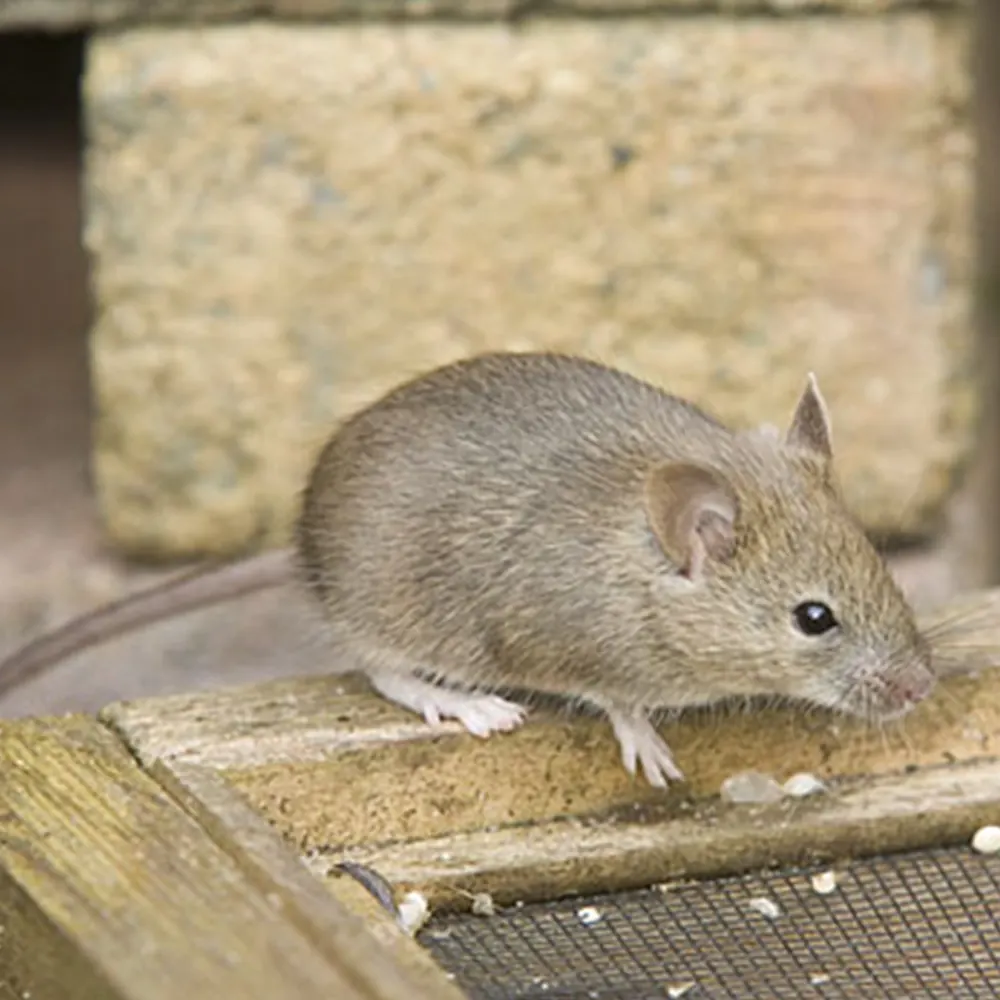
The house mouse is small and slim, grey-brown with a paler belly, large rounded ears and a tail about as long as its body. Its droppings are tiny, dark and shaped like grains of rice, scattered rather than in piles. A young rat is easy to mistake for a mouse, but look at the feet and head: a young rat has oversized feet and a heavy, blunt head for its size, while a mouse is delicate all over.
How quickly mice multiply
Mice mature within a couple of months and breed throughout the year indoors, producing litter after litter in a warm, sheltered spot. They need very little water, getting most of it from food, so a kitchen or pantry can support a whole family without a tap in sight. That's why a problem that started with one sighting in autumn can be a dozen mice by midwinter.
Where mice live in a house
- The empty space behind the kick plates under kitchen units, the most common nest site we find
- Behind and under the stove, fridge and dishwasher, where motors keep things warm
- Inside wall cavities and around geyser cupboards
- Stored boxes, linen and old furniture in the garage or spare room
- Roof insulation, especially above the kitchen
- The engine bay of a car that stands for a few days
That last one surprises people. Mice nest beside warm engines and chew wiring and air filters, which can mean an expensive repair. If you're finding droppings in the bonnet, the garage needs attention too.
Signs of mice
Droppings along skirtings and in drawers, nibbled food packets with small neat holes, shredded paper or fabric gathered into a nest, a musky smell in a closed cupboard, and light scratching in the walls at night. Pets often notice first: a cat or dog staring at the same kitchen unit for days is worth taking seriously.
Why mice are so hard to clear yourself
A mouse rarely travels more than a few metres from its nest, and it nibbles a little from many places rather than eating a full meal from one. A single trap in the middle of the kitchen may never be visited by mice living behind the dishwasher. Traps need to sit close together, flush against walls, in the exact areas the mice use. Store-bought poison sachets left loose get dragged into wall voids or eaten by the dog. And unless the entry gap is found, more mice keep arriving from the garden, the neighbour or the shared roof.
How we treat mice
We start by working out where the mice are nesting and where they're coming in. Inside, we place traps and, where it's safe, small tamper-resistant stations in the voids and runs mice use, often removing kick plates to reach them. Outside, lockable stations cover the approach routes. A follow-up visit checks activity, clears traps and moves anything that isn't working. We then show you each gap to close.
Proofing against mice
A mouse can get through a hole about the width of a pencil, so proofing is detail work:
- Seal holes where pipes and cables pass through walls and into units, using steel wool packed with filler or cement.
- Fit brushes or rubber strips to the bottom of external doors and garage doors.
- Cover air bricks with fine steel mesh.
- Close the gaps around the stove and dishwasher connections behind the units.
- Store dry food, birdseed and pet food in hard plastic or glass containers.
Don't block weep holes at the base of brick walls with cement; they let moisture out. Fine mesh keeps rodents out without trapping damp.
Mice in flats, offices and complexes
In blocks of flats and office buildings, mice move through service ducts, ceiling voids and cable trunking from one unit to the next. Treating one flat helps that flat for a while, but the building needs a joint plan through the body corporate or managing agent. Offices with kitchens and server rooms are especially at risk, because chewed data cables are costly. We set up scheduled monitoring for commercial buildings with a record of every check.
The thing people get wrong
Stopping as soon as the droppings disappear. A quiet week can mean the mice have simply moved to another cupboard. Keep traps out for a while after the last catch, and check that every gap is sealed before calling it done.
What mouse control costs, and why
The cost depends on how many rooms are involved, whether units need to be opened up, how many follow-up visits it takes and how much proofing is needed. A single kitchen in a house is a small job; a block of flats or an office building is quoted for the whole site. Guide prices are on our pest control prices page. If you've seen one mouse once, try two or three snap traps baited with a little peanut butter along the wall first.
If the droppings look bigger than rice grains, read our guide to rats instead. For local service, see mouse control in Johannesburg or mouse control in Randburg, where older homes and busy main roads keep us busy every winter, and our wider rodent guide covers proofing in more depth.
Combat Pest Control is SAPCA registered, registered with the Department of Agriculture under Act 36, and run by Jason van Heerden with 25 years' experience. We offer service within 24 hours and a 3-month guarantee on mouse treatments. Call 084 200 2700, or WhatsApp a photo of the droppings and we'll tell you whether it's mice.

Questions we get asked
How much does it cost to get rid of mice?
It depends on the number of rooms, how hard the nests are to reach and how many follow-up visits are needed. A single kitchen is a small job; flats and offices are quoted per building.
If I've seen one mouse, are there more?
Usually, yes. Mice breed quickly and live in family groups, so one sighting often means a nest nearby, typically behind kitchen units or appliances.
What's the best bait for a mouse trap?
A small amount of peanut butter works well. Place traps flush against walls in the area where you've found droppings, a short distance apart.
Is mouse treatment safe for my pets?
Yes. We use traps and lockable, tamper-resistant stations placed where pets can't reach. Cats and dogs can stay at home throughout.
How long does it take to clear mice?
Most homes are clear within a couple of weeks once the nest is found and the entry gaps are closed. Shared buildings take longer.
Can mice damage my car?
Yes. Mice nest in engine bays and chew wiring and air filters. If you find droppings under the bonnet, treat the garage and keep the car moving.
Will ultrasonic plug-in repellers get rid of mice?
Not reliably. Mice get used to the sound quickly, and the devices don't reach behind units or into walls where mice nest.