
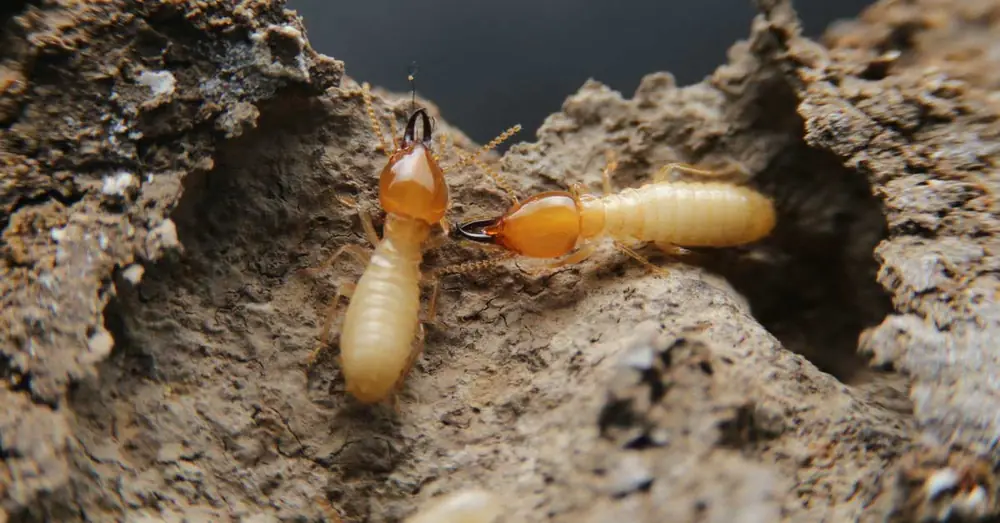
Termite control in Randburg means first working out which termite you have. In older suburbs it's usually subterranean termites in skirting boards, cupboards and door frames; in complex gardens and family lawns it's often harvester termites stripping the grass in winter. We inspect, identify the species and treat the colony with registered products, backed by a 5-year guarantee.
Two termites, two very different jobs
Most Randburg termite calls start with one of two sentences: "there's mud on my wall" or "my lawn is dying". They sound related, but they're different insects with different habits.
Subterranean termites nest in the soil and forage for timber and anything made from cellulose: roof trusses, skirting, door and window frames, cupboard backs, cardboard boxes, even the paper face of ceiling boards. Because they dry out quickly in open air, they travel inside sealed earth tubes, which is why the first sign is so often a thin brown line climbing a foundation wall or running up the inside of a cupboard.
Harvester termites leave the house alone and go for the grass. Workers come up through small holes, cut the leaves into short pieces and carry them underground. You see bare, sandy patches, loose soil heaps around tiny openings and bits of cut grass lying on the surface.
Why Randburg properties are vulnerable
Older homes in Ferndale, Blairgowrie, Bordeaux and Linden
Much of Randburg's older housing dates from decades when built-in cupboards, timber skirting and wooden door frames were standard, and many homes still have timber floors or wooden roof trusses resting on brick walls. Every time soil is piled against a wall or a new room goes onto fresh foundations, a gap can open in whatever protection the house originally had. Our inspections in these suburbs regularly turn up activity behind kitchen cupboards on outside walls, in back-door frames next to a garden tap, and in garages where boxes stand on the floor.
Complexes and newer homes towards Northriding and Olivedale
The newer side of Randburg carries a different risk. Many complexes went up on former veld, where termite colonies were living long before the first slab was poured. If the soil was pre-treated properly and the treated zone hasn't been disturbed, the buildings usually hold up well. Trouble starts when rubble, offcuts or tree roots were buried during construction, when owners lay new paving or patios, or when a body corporate replants the gardens and irrigation keeps the soil against the walls permanently damp. The big communal lawns in these complexes are also prime harvester termite territory in a dry winter.
The Highveld calendar
Termite activity here follows the rain. After the first proper storms, usually from October, mature colonies release swarms of winged termites, often called flying ants, to start new colonies. Winged termites in the garden are normal; winged termites emerging from inside a wall, floor or cupboard mean a colony is already using the building. In the dry, frosty months from May to August, harvester termites do their visible damage, because stressed grass is easy to cut and there's little else for them to eat.
Is it termites or wood borer?
Older Randburg homes also get wood borer, and the two are easy to confuse. Termites leave earth tubes and soft, hollow timber packed with soil; borer leaves neat round exit holes and fine powdery dust underneath. We confirm which it is before quoting. If it turns out to be beetles, our page on wood borer treatment in Randburg explains the next step.
How we treat termites in Randburg
- A full inspection. Foundations, outside walls, built-in cupboards, door and window frames, the garage, the roof space and the garden.
- Finding the species and the route. Expansion joints, cracks in the slab, pipe entries, soil against brickwork and timber touching the ground are the usual ways in.
- Subterranean termites. Registered soil treatments applied around and, where needed, under the structure to create a treated zone the colony can't cross, drilling through paving or floors at set points. Where drilling isn't practical, baiting can be used instead.
- Harvester termites. Treatment of the active nest openings in the lawn, timed for when the workers are foraging, so they carry the product down into the colony.
- Follow-up and certificate. We return where needed to confirm the activity has stopped, and you receive a treatment certificate backed by our 5-year termite guarantee.
Building, renovating or extending?
Randburg sees a lot of renovation: new garages, granny flats, enclosed patios and second storeys on older homes. Any new foundation is a chance to protect the building cheaply, before concrete covers the soil. A soil pre-treatment before the slab is cast puts a treated barrier under the new work. It matters even more on an extension, because otherwise the new section can become the bridge that lets termites into the old house.
The mistake we see most
Scraping off the mud tubes and spraying the termites inside. That kills a handful of workers and prompts the colony to build a new tube somewhere less visible, often inside the wall. The other common one is reseeding or re-turfing a lawn hit by harvester termites without treating first: the new grass simply becomes the next meal. Leave tubes and holes alone until we've seen them, because they're what we use to trace the activity.
A Randburg prevention tip
Walk around the house and check the ground line. In established Randburg gardens, years of compost, bark chips and raised beds often bury the damp-proof course, giving termites a hidden path into the brickwork. Keep soil and mulch a good hand's width below it, and fix taps and irrigation that keep the base of the walls wet. In winter, a deep watering every week or two helps a lawn hold out against harvester termites.
What termite control costs, and why
Termite jobs vary more than almost any other pest work, so we quote after the inspection. The main cost drivers are:
- The species: treating harvester termites in a lawn is a far smaller job than protecting a house against subterranean termites.
- The perimeter of the building, and how much paving, tiling or slab has to be drilled.
- Whether baiting suits the property better than a soil treatment.
You'll find where termite work starts on our Johannesburg pest control prices page, and this page shows the guide "from" price too. If a few harvester holes on the verge are all you have, we'll tell you honestly whether it needs us.
For background on termites across the city, see termite control throughout Johannesburg. We also treat termites in Northcliff just to the south, and Blairgowrie's older homes have their own Blairgowrie pest control page. Everything else we handle locally is on our Randburg pest control hub.
Combat Pest Control is run by Jason van Heerden, with 25 years in the trade. We're SAPCA registered and registered with the Department of Agriculture under Act 36, and we offer service within 24 hours. Found mud tubes or a bare lawn? Call 084 200 2700, or WhatsApp us a photo and we'll tell you which termite it is.

Questions we get asked
How much does termite treatment cost for a Randburg house?
It depends mainly on which termite it is and the size of the building. Harvester termites in a lawn cost far less to treat than subterranean termites in a house, where the perimeter and the amount of paving to drill set the price. We quote after inspecting.
What does the 5-year termite guarantee mean?
If termites come back in the treated area within five years, we come back and deal with them, and you get a treatment certificate for your records. Let us know before any building work or new paving, because that can disturb the treated zone.
Are the flying ants after the first rain actually termites?
Often, yes. Winged termites swarm after the first summer storms. A swarm in the garden is normal, but if they're coming out of a wall, floor or cupboard, a colony is using the house and it needs an inspection.
Our complex was pre-treated when it was built. Are we still covered?
Not necessarily. Soil treatments wear off over the years, and new paving, patios and replanted beds break the treated zone. If you're seeing tubes or swarmers, have it checked.
Will you need to drill through my tiles or paving?
Sometimes. For subterranean termites we may drill small holes at set points to get the treatment into the soil under paving or floors, then close them. Where that isn't practical, baiting is an option.
Can my dogs stay in the garden during treatment?
Keep them away from treated areas until they're dry, and we'll show you exactly where those are. You and your family can stay at home throughout.
Will my lawn grow back after harvester termites?
Usually, once the colony has been treated. Water and feed the lawn through the dry months. Re-seeding before treatment just gives the termites more to eat.
What should I do before you come out?
Leave any mud tubes and nest holes untouched, clear access to built-in cupboards, the garage and the roof hatch, and note where you've seen activity. Please don't spray anything yourself.