
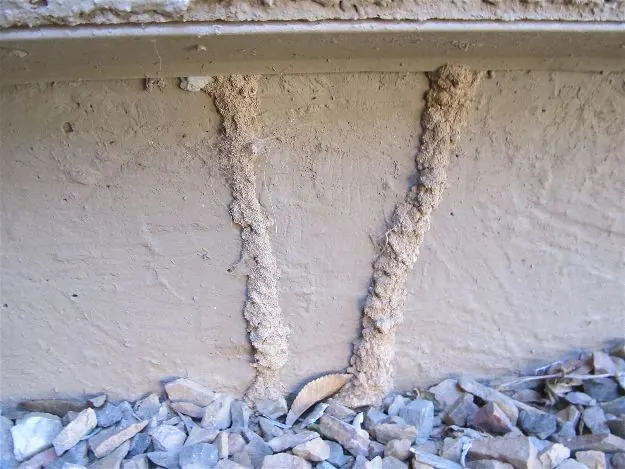
Termite pre-treatments in Johannesburg protect a new house, extension or commercial building before it exists. We treat the prepared soil under the floor area and along the foundations with a registered termiticide just before the damp-proof membrane and slab are laid, so subterranean termites meet a treated zone. You get a treatment certificate and a 5-year termite guarantee.
Why pre-treat at all
Subterranean termites are common in Highveld soils. Colonies live underground and forage outward through sealed mud tunnels, and a new building simply sits on top of whatever is already there. Within a few years of handover, they can be coming up through expansion joints, cracks in the slab, plumbing penetrations and the gap where a wall meets the floor, into skirting boards, door frames, kitchen units and built-in cupboards. Once a building is up, the only way to treat underneath it is by drilling through floors and paving. Before the slab, the whole footprint is open soil and a pre-treatment covers it properly in one visit. It's the cheapest termite protection a building will ever get.
There's a paperwork reason too. Building inspectors, financing banks and future buyers often want proof that the soil was treated, and the certificate we issue for each pre-treatment is that proof. The work follows SANS 10124, the national standard covering how soil is treated against termites.
When we treat: the stages on site
Timing is everything, and it depends on how the building is being constructed. On a typical new house in Johannesburg:
- Foundation trenches. Once the trenches are dug, and before the foundation concrete is poured, the trench bottoms and sides can be treated so the foundations themselves sit in treated soil.
- Under the floor slab. This is the main treatment. After the foundation walls are up, the fill inside them has been placed and compacted, and the plumbing and electrical sleeves are in, we treat the whole surface of the fill. The damp-proof membrane and slab must follow soon after, before the treated surface is disturbed.
- The perimeter, after backfill. Once the building is up and the soil around it has been backfilled and levelled, the outside edge along the foundations can be treated to complete the zone. Ideally this happens before paving and landscaping go in.
Raft foundations, double-storey buildings on sloping stands and commercial slabs vary, so we agree the stages with the builder or site agent at the start rather than on the day.
What your builder needs to do
- Call us at the right moment. Not after the plastic is down. Most missed pre-treatments happen because the slab was poured a day early.
- Finish compaction and services first. Every trench dug through the treated fill afterwards, for a forgotten drain or a conduit, breaks the zone.
- Clear rubble and timber. Offcuts, formwork and tree roots left in the fill are termite food sitting under the new floor.
- Protect the treated surface. Keep traffic and wheelbarrows off it, and cover it with the membrane and slab as soon as practical.
- Watch the weather. Heavy summer storms can wash product off loose fill. If a big storm hits before the slab goes down, phone us to check the site.
Extensions, garages and outbuildings
An extension is the job most often skipped, and it's a real risk. If the original house was pre-treated, the new section sits on untreated soil right against it, and termites can use it as a bridge straight into the old building. If the original was never treated, the extension is a good moment to treat the new section and look at the rest. Granny flats, garages, staff quarters, pool rooms and wooden decks on soil all deserve the same thought, especially where timber is involved.
Where we do the most pre-treatment work
New houses and estate developments on the northern edges of the city account for a lot of it: estates around Fourways, Lonehill and Dainfern, and the developments and office parks spreading through Midrand and Kyalami. These sites are often on former veld or farmland, where termite colonies were living long before the first bulldozer arrived. Our pages on termite control in Fourways and Midrand termite treatments cover what we see in those areas once buildings are up. Older suburbs see more extensions, second storeys and cottage builds than new houses, and each of those needs its own pre-treatment.
Pre-treatment or soil poisoning later?
The two are related. "Soil poisoning" is the everyday term for treating soil against termites, and it can be done before building or after. A pre-treatment is simply soil treatment done at the stage where it's easiest and most complete. Once a building is finished, protection is still possible, but it means trenching along walls and drilling through paving and patios, which takes longer, costs more and can never reach every square metre under the slab. Our soil poisoning in Johannesburg page explains how existing buildings are treated.
The mistakes we see
The slab going down before we've treated, because nobody phoned. Treating the fill and then digging a fresh trench through it for a late plumbing change. Burying building rubble and offcuts in the garden beds next to the new house. And assuming that because a house was pre-treated when it was built, it is protected forever. Soil treatments do break down over time, and paving, pools, new flowerbeds and extensions disturb the treated zone. If your home is more than a few years old and you've done work around it, have it checked.
A Highveld building tip
Keep finished ground levels and planting beds below the damp-proof course, and don't let garden soil, bark mulch or paving bridge onto the wall above it. On many new Johannesburg homes, the landscaping that goes in last undoes the pre-treatment that went in first, by giving termites a covered route straight up onto the brickwork and into the frames.
What it costs and why
Pre-treatment is priced mainly on the area being treated: the slab footprint, plus the foundation trenches and the perimeter if those stages are included. The number of site visits matters too, because a job done in three stages takes three trips. A small extension or garage is a modest job, a large double-storey home costs more, and commercial slabs and estate developments are quoted on plans. Whatever the size, it costs a fraction of treating the same building for termites after it's finished. See our pre-treatment price guide for starting prices, and send us the plans or slab dimensions for a quote.
Learn more
Our termite pre-treatment guide explains how termiticides work in the soil, and if you already have termites in an existing building, start with termite control in Johannesburg.
Combat Pest Control is owned and operated by Jason van Heerden, with 25 years in pest control, SAPCA registration and registration with the Department of Agriculture under Act 36 of 1947. Each pre-treatment comes with a certificate and our 5-year termite guarantee, and we offer service within 24 hours so the builder isn't kept waiting. Call 084 200 2700 to book, or WhatsApp us a photo of the site so we can check it's ready.

Questions we get asked
How much does a termite pre-treatment cost?
It depends mainly on the slab area and how many stages are treated. An extension or garage is a modest job; a large home costs more; commercial slabs are quoted on plans. It's always far cheaper than treating a finished building.
When should the builder call you?
When the fill inside the foundations has been compacted and the plumbing and electrical sleeves are in, before the damp-proof membrane goes down. If foundation trenches are being treated too, call before the foundation concrete is poured.
Do I get a certificate?
Yes. Every pre-treatment comes with a treatment certificate for the building inspector, the bank or future buyers, and a 5-year termite guarantee.
What happens if it rains after the treatment?
Light rain is usually fine. A heavy storm on loose, freshly treated fill before the slab is cast can wash product away, so phone us and we'll check whether a top-up is needed.
Does an extension need its own pre-treatment?
Yes. Untreated soil under a new section gives termites a route into the whole building, even if the original house was treated.
Is the product safe for the builders on site?
Yes, when it's applied correctly. Workers keep off the treated surface until it has soaked in, and it's then covered by the membrane and slab.
How long does a pre-treatment protect the building?
For years, as long as the treated zone isn't disturbed. Our 5-year termite guarantee covers the treatment, and later work such as paving, pools and new beds should be checked.