
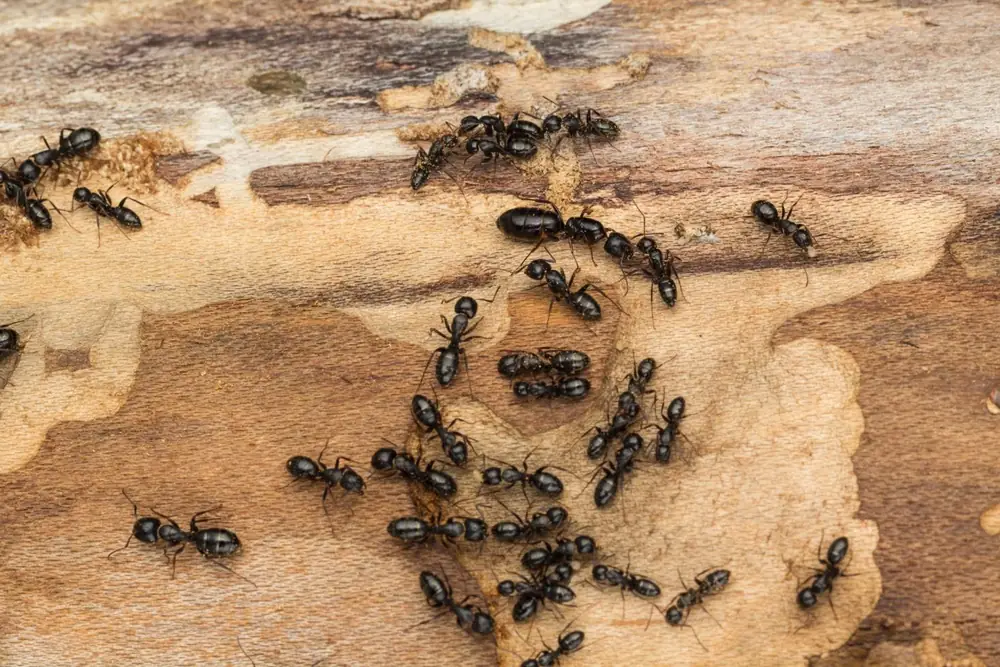
This ant guide explains why the line of ants across your counter is only the delivery team. The colony lives out of sight in soil, walls or paving, so lasting ant control uses baits the workers carry home to the nest and its queens, plus targeted treatment of nests and entry points, rather than spraying the trail.
How an ant colony works
Every colony has one or more queens, whose only job is laying eggs, and thousands of workers that forage, build and care for the young. Foragers that find food lay a scent trail back to the nest so others can follow it, which is why ants march in neat lines. Food is shared mouth to mouth throughout the colony. That sharing is the key to control: a slow-acting bait that foragers carry home ends up feeding the queens and larvae too.
Ants you'll meet in and around Johannesburg homes
Argentine ants
Small, uniform light to dark brown ants that move in fast, busy trails. Colonies have many queens and spread across whole blocks of gardens, so they are persistent, and they love sweet food, honeydew from aphids and moist spots in kitchens and bathrooms.
Pugnacious ants
Larger, shiny black or brown ants that nest in lawns and paving, push up heaps of sand between pavers and bite when disturbed. They farm aphids and scale insects on garden plants and often swarm across patios in summer.
Pharaoh ants
Tiny, pale yellowish ants that nest inside wall voids, behind skirtings and in electrical fittings. They're a common problem in flats, hospitals and older buildings. Spraying them causes colonies to split into several new ones, known as budding, which spreads the infestation.
Large black ants at night
Big black ants that wander indoors after dark are often nesting in damp or hollow timber, roof spaces or the cavity of a wall, and are worth tracing to the nest.
Our article on identifying ant activity helps you work out which you're dealing with.
Why ants pour indoors before a storm
On the Highveld, ants often stream into the house a day or two before heavy summer rain, and again in hot, dry spells. Rising humidity and falling pressure push them to protect the colony and find food and higher ground; heat sends them looking for water. A sudden invasion doesn't always mean a new nest, but it does show you their routes in.
Why spraying the trail makes things worse
Spraying kills the foragers you can see, which might be a small fraction of the colony. The queens keep laying, and the trail simply reroutes. Repellent sprays can make multi-queen species like pharaoh ants split into several colonies, and they contaminate baits so the ants refuse them. Boiling water down a nest hole in the lawn kills the top layer and nothing more.
How baiting works, and why it's slow
A good ant bait is attractive enough for workers to carry home and slow enough that they share it widely before it takes effect. Ant preferences change through the year: at times a colony wants sugar, at others protein or oil for the growing larvae. That's why we sometimes use more than one bait and why identifying the species matters. Expect to see more ants on the bait for the first day or two. That's a good sign. Leave them to feed, and activity usually drops sharply within a week or two.
Ants in electrical equipment
Ants are attracted to the warmth and electrical fields of switches, plugs, distribution boards, gate motors, pool pumps and alarm panels. Nests inside these can cause faults and short circuits. Never spray liquid insecticide into electrical equipment. We use dust or bait placed safely around these sites, and recommend an electrician switch off and open anything that needs direct treatment.
Lawns, paving and patios
Ants nesting under paving push sand up between the joints and undermine the pavers over time. Pugnacious ants in lawns are treated at the nests with a registered product, while bait stations on the paving deal with foragers. Control aphids and scale on garden plants too, because ants guard them for their sugary honeydew.
Keeping ants out
- Wipe up sugary spills and crumbs, and store honey, jam and sugar in sealed containers.
- Don't leave pet food standing; feed and lift the bowl.
- Seal gaps around window frames, skirtings and where pipes enter the house.
- Cut back plants touching the walls, which ants use as bridges.
- Rinse recycling before it goes in the bin.
What ant control costs, and why
The price depends on the species, the number and location of nests, the size of the house and garden, whether wall voids or electrical equipment are involved, and whether a follow-up visit is needed. A single trail into a kitchen can often be handled with a good ant bait from the shops, placed on the trail and left alone. Large properties, multiple species or pharaoh ants in a building need professional work. Guide prices are on our pest control pricing page.
For local treatment, see ant control across Johannesburg or ant treatments in Fourways, where new estates and landscaped gardens give ants plenty of room. If you're seeing cockroaches in the same kitchen, our cockroach guide explains why baiting works for them too.
Combat Pest Control holds SAPCA membership and Department of Agriculture registration under Act 36, and Jason van Heerden brings 25 years of experience to every job. We offer service within 24 hours and a 3-month guarantee on ant treatments. Phone 084 200 2700, or WhatsApp a close-up photo of the ants for identification.

Questions we get asked
How much does ant control cost?
It depends on the species, how many nests there are and the size of the property. A house with one or two trails is a modest job; large gardens, buildings with pharaoh ants and electrical nests cost more.
Why are there more ants after the bait was put down?
That's the bait working. Workers recruit others to the food and carry it back to the nest. Leave them to feed and don't spray them.
How long does it take to get rid of ants?
Most infestations drop sharply within one to two weeks of baiting. Multi-queen species and large colonies may need a follow-up.
Are ant baits safe around pets?
Yes, in the amounts and places we use them. Baits go in cracks, stations and nest sites, away from pet bowls and play areas.
Why do ants come in before it rains?
Changes in humidity and pressure before a storm push ants to move food and brood to safety, and your house is a dry, food-rich option.
Can ants damage my electrics?
Yes. Ants nest in switches, plugs, gate motors and distribution boards and can cause faults. Don't spray liquid into electrical equipment.
What should I do before you come?
Stop spraying the ants a few days before, leave the trails visible, and note where they come in and where they go.