
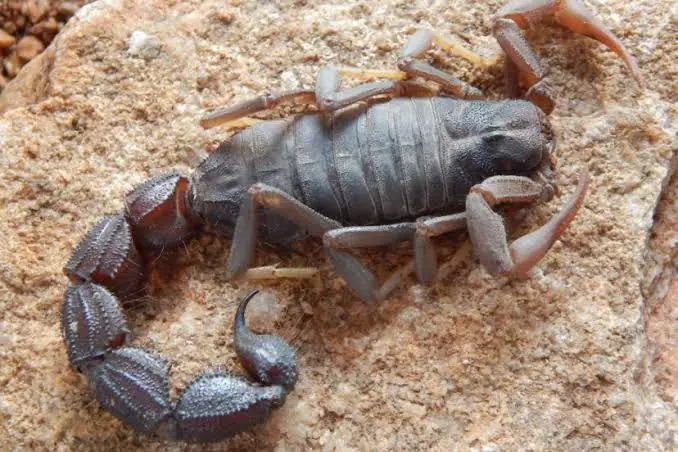
This scorpion guide explains how to tell the more dangerous Gauteng scorpions from the mostly harmless ones, where they hide and how to keep them out. As a rule, a thick tail with slender pincers means a more venomous species. Scorpion control combines removing shelter around the house with residual treatment of entry points and hiding spots.
The tail-and-pincer rule
South African scorpions fall broadly into two groups, and the shape of the body gives you a quick guide.
- Thick tail, thin pincers: these scorpions rely on venom to subdue prey, so their venom is stronger. The thick-tailed species are the ones that cause serious stings, especially in children and older people.
- Thin tail, large pincers: these scorpions grab and crush prey with powerful pincers and rely less on venom. Their sting is painful, like a bee sting, but rarely dangerous.
It's a rule of thumb, not a guarantee. Treat every scorpion with care, and never pick one up.
Where scorpions live around Johannesburg
Scorpions like dry, sheltered spots with gaps to hide in during the day. Properties on or near the ridges, rocky outcrops, koppies and nature reserves see the most, along with homes on the edges of open veld. Around the house they hide under rocks and rockery stones, in stacked bricks and paving, in wood piles, under pot plants and garden ornaments, in cracks in boundary walls, and in the gaps of stone cladding. Burrowing species dig tunnels in compact soil, often under paving edges.
How scorpions behave
Scorpions are night hunters, feeding on insects, spiders and other small creatures. They're most active on warm summer nights and often come inside through gaps under doors, open sliding doors and weep holes, or are carried in on firewood and pot plants. They can survive a long time without food, have a slow metabolism and tough outer skin, which makes them harder to kill than most household pests. Interestingly, scorpions glow under ultraviolet light, and a UV torch on a summer night shows you exactly where they're hiding in the garden.
If someone is stung
Keep the person calm and still, and if you can, take a photo of the scorpion. Wash the sting site and apply a cold compress for the pain. Get medical help quickly if the scorpion had a thick tail, if the person is a child or elderly, or if symptoms spread beyond local pain: numbness or tingling, muscle twitching, difficulty swallowing or breathing, or drooling. Don't cut the sting site or apply a tourniquet.
Why sprays struggle with scorpions
A scorpion sprayed directly may survive longer than you'd expect, and those hiding in rock gaps and wall cracks never come into contact with a quick spray. Because they don't need to eat often, baits designed for insects are seldom effective. Control has to combine treatment of their hiding and travel routes with reducing the shelter and prey around the house.
What we do
We inspect the garden and the outside of the house to find where scorpions are hiding and how they're getting in. A residual treatment is applied to the base of outside walls, door and window frames, weep holes, gaps under doors, rockeries and garden walls, wood piles and other harbourage. Inside, we treat entry points, skirtings and the areas where scorpions have been seen. Where insect numbers around the house are high, we treat those too, since they're the scorpions' food. Treatments are odourless and non-staining, and you stay home. Keep children and pets off treated surfaces until dry.
Scorpion-proofing your home
- Fit door seals or brushes to external doors so there's no gap at the bottom.
- Cover weep holes with fine mesh rather than filling them, so walls can still drain.
- Move rockeries, wood piles, bricks and stacked pots away from the house walls.
- Keep beds away from walls and don't let bedding touch the floor.
- Shake out shoes, boots and clothes left on the floor before putting them on.
- Wear gloves when gardening or moving stones and wood.
- Reduce outside lighting near doors, which draws the insects scorpions hunt.
The mistake we see most
Building a beautiful rockery or stone feature right against the house wall. It creates perfect scorpion habitat a step away from the door. If you love rocks in the garden, keep them a few metres from the building and away from children's play areas.
What scorpion control costs, and why
The cost depends on the size of the property, how much rockery, stonework and harbourage there is, whether outbuildings are included and whether follow-up visits are needed through summer. A suburban house is a modest job; a large stand on a ridge or next to veld takes considerably more work. Our pest control price list shows where scorpion treatment starts. If you find a single thin-tailed scorpion, catching it under a glass and releasing it far from the house is a perfectly reasonable answer.
Spiders share many of the same hiding spots; see our spider guide. For local help, see scorpion control in Johannesburg, scorpion treatment in Roodepoort near the ridges and botanical garden, or our Northcliff pest control page for homes on the ridge.
Combat Pest Control is owned and run by Jason van Heerden, with 25 years in the trade, SAPCA membership and Department of Agriculture registration under Act 36. We offer service within 24 hours, and if scorpions return within 3 months of treatment, so do we. Call 084 200 2700, or WhatsApp a photo of the scorpion and we'll tell you what it is.

Questions we get asked
How much does scorpion control cost?
It depends on the size of the property, how much rockery and stonework there is, and whether follow-up visits are needed. A suburban house is a modest job; ridge and veld properties cost more.
How do I know if a scorpion is dangerous?
Look at the tail and pincers. A thick tail with slender pincers usually means stronger venom. Treat every scorpion with care regardless.
What should I do if my child is stung?
Keep them calm, apply a cold compress and get medical help straight away, especially if the scorpion had a thick tail or symptoms spread.
Is scorpion treatment safe for pets?
Yes, once dry. Keep pets off treated surfaces until then. The treatment goes on walls, frames and harbourage, not on lawns where pets play.
Why are scorpions coming into my house?
They hunt insects at night and come in through gaps under doors, weep holes and open sliders. Rockeries and wood piles next to the house make it easy.
When are scorpions most active?
On warm summer nights. They're much less active in the cold Highveld winter.
Do I have to leave the house?
No. Scorpion treatments are mainly outdoors and at entry points. You can stay at home.