
Bird proofing means physically stopping birds from landing, roosting or nesting on a building, using spikes, netting and sealed gaps rather than poisons or scare tactics. This bird proofing guide explains which birds cause problems in Johannesburg, which method suits which spot, and why proofing usually has to follow a proper clean-out.
The birds that cause the trouble
Feral pigeons are the biggest nuisance by volume. They roost in flocks on ledges, signage, balconies and the flat spaces under solar panels, and a regular roost produces a lot of droppings very quickly. Indian mynas are smaller, noisier and bolder; they push nest material into any gap under roof tiles, into eaves and behind gutters. Sparrows and starlings do the same on a smaller scale. Most of our bird proofing work in the city involves one of these.
Protected indigenous birds are a different matter. We won't proof a building in a way that traps or harms nesting birds, and if an indigenous species is involved we'll wait until the young have left before closing anything off.
Why birds on a building are more than a mess
- Droppings are acidic, stain paving and paint, block gutters and downpipes, and become slippery on walkways and fire escapes.
- Nests in roofs and gutters cause damp, blocked drainage and, in some cases, a fire risk near electrical fittings.
- Parasites come with the nests. When birds leave, their mites go looking for a new host, and that host is often you. Our bird mite guide covers that problem in detail.
- Food businesses with birds near loading bays, rooftop extractors or outdoor seating face hygiene questions at audit time.
The main bird proofing methods
Spikes
Blunt spikes on a strip are fixed along ledges, parapets, signage and beams so that birds can't land comfortably. They don't injure birds. Spikes work best on narrow surfaces and lose their effect if they're installed with gaps or if debris builds up between them.
Netting
Netting closes off a whole area: a courtyard, the space under a carport, a loading bay roof or a balcony. Properly tensioned and fixed to a frame, it's the most complete solution for large spaces where pigeons roost in numbers. Badly fitted netting sags, tears and ends up trapping birds, which is worse than having none.
Sealing gaps
For mynas and sparrows getting into roofs, the answer is usually to seal the gaps at the eaves, under the first row of tiles and around fascia boards and pipe entries. This is careful, close work and it has to be done once the birds and their nest are out.
Solar panel proofing
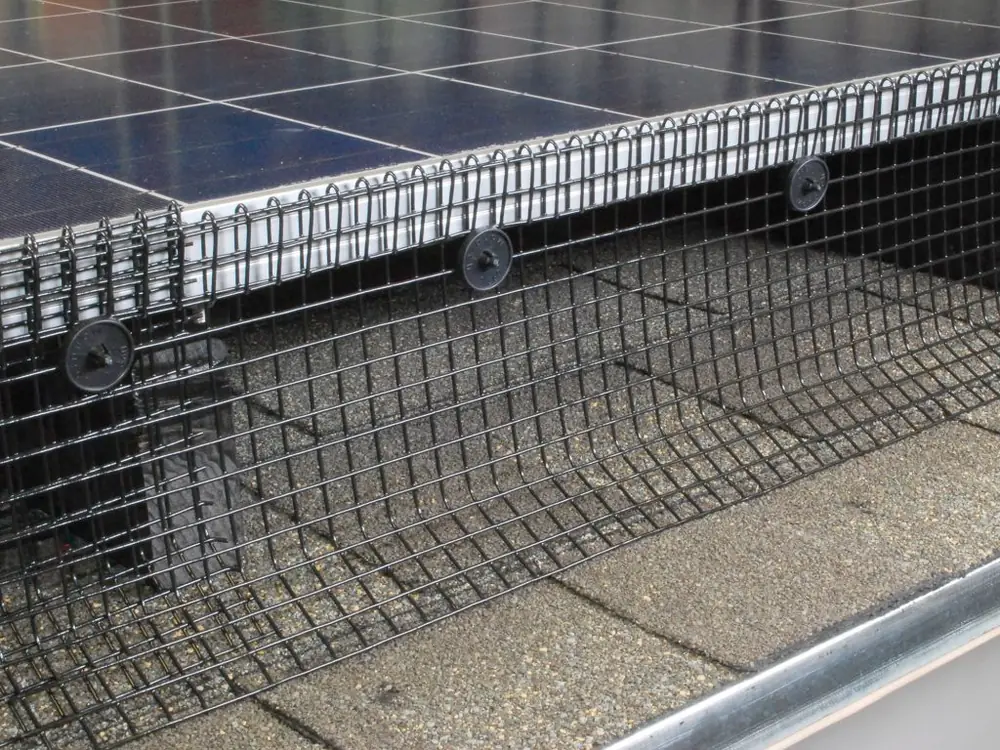
Solar panels have created a new favourite spot for pigeons across Johannesburg: sheltered, warm and out of reach. The gap between the panels and the roof is closed with mesh fixed around the edge of the array, which keeps birds out without drilling into the panels themselves.
How a bird proofing job works
- Survey. We look at where birds land, roost and nest, and how they get in. Often the problem spot isn't the one you can see from the garden.
- Clean-out. Nests and heavy droppings are removed first. Proofing over an active nest just traps birds or chicks inside.
- Treat for parasites. Where nests have been removed, the site is treated so mites don't migrate into the building.
- Install. Spikes, netting or sealing, chosen for each surface rather than one method for the whole building.
- Check. Pigeons are persistent. We check that birds aren't finding a way around the new barriers.
What people often get wrong
The two most common mistakes are plastic owls and partial proofing. Fake predators work for a week, then the pigeons sit on them. And proofing one ledge while leaving the next one open just moves the flock a metre along. Birds are loyal to a roost, so the whole of the area they use needs to be dealt with at once. Feeding birds in the garden, even a little, keeps them coming back to the roof as well.
What bird proofing costs, and why
Bird proofing is quoted per job because buildings differ so much. The main factors are the length of ledge or the area to be netted, the height and whether access equipment is needed, how much clean-out is required first, and whether parasites need treating. Sealing a few gaps under a single-storey roof is a modest job. Netting a loading bay or proofing a large solar array costs more. You can see the guide "from" price on our pest control price list, and we'll give you a written quote after the survey.
A Johannesburg tip
Check your roof at the end of winter, before nesting really gets going. Mynas start carrying grass under tiles in late winter and spring, and sealing the gap before eggs are laid is far easier than dealing with a nest, chicks and mites a month later.
Related problems
Birds and rodents often share the same roof gaps. If you're also hearing scratching at night, see our rodent control across Johannesburg. For homes and businesses that need proofing alongside regular pest work, our bird proofing service in Johannesburg page explains how we fit it into a visit.
Behind Combat Pest Control is Jason van Heerden, owner and operator, with 25 years in the trade. We hold SAPCA membership and Department of Agriculture registration under Act 36 of 1947, and we can usually have someone with you within 24 hours. To book a bird proofing survey, call 084 200 2700, or WhatsApp us a photo of where the birds are sitting.

Questions we get asked
What does bird proofing cost?
It depends on the size of the area, the height and access, how much cleaning is needed first and whether bird mites need treating. Small sealing jobs are modest; large netting jobs cost more. We quote after a survey.
Do bird spikes hurt the birds?
No. The spikes are blunt and simply stop birds landing comfortably. They're designed to deter, not injure.
How do I stop pigeons nesting under my solar panels?
Fit mesh around the edge of the panel array to close the gap between the panels and the roof. Clear any nests and droppings first so no birds are trapped underneath.
Can I just block the hole the mynas use?
Only once the nest is empty and removed. Blocking an active nest traps chicks or adults inside, which causes a smell, maggots and bird mites.
How long does bird proofing last?
Well-installed spikes, netting and sealing last for years. They need occasional checks, especially netting, and spikes should be kept clear of debris.
Do plastic owls or reflective tape work?
Only briefly. Pigeons learn within days that a fake predator doesn't move, so physical proofing is the reliable answer.
Do you work on office blocks and warehouses?
Yes. We proof ledges, signage, loading bays and rooftop plant on commercial buildings, and can arrange the work around trading hours.