
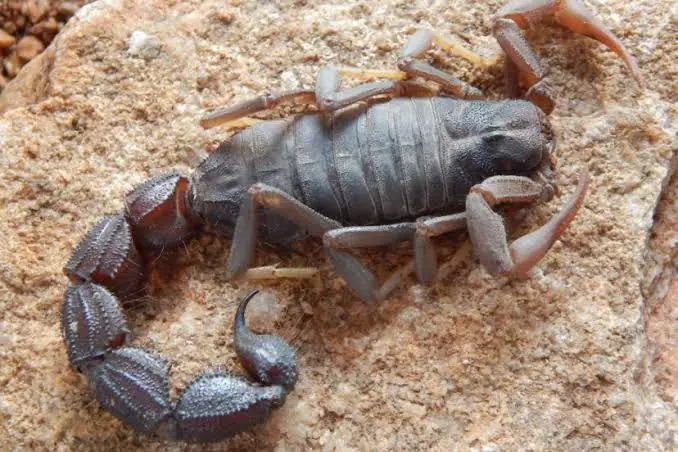
Scorpion control in Sandton focuses on where scorpions shelter: rockeries, stone retaining walls, paving, wood piles and garden clutter. We inspect the property, identify the type of scorpion, treat harbourage areas and entry points with a residual product, and advise on sealing door gaps so scorpions stay outside where they belong.
The scorpions you're likely to see
Gauteng has several scorpion species, and the simplest guide to the risk is the shape. Scorpions with thick tails and thin, slender pincers have the more potent venom and need more caution. Scorpions with large, heavy pincers and a thin tail rely on their claws and generally have milder stings, which are painful but rarely dangerous for healthy adults. Both kinds turn up in Sandton gardens. Any sting on a small child, an elderly person or someone with a heart condition, or a sting followed by numbness, difficulty swallowing or breathing, needs medical help straight away.
Why scorpions turn up in Sandton
Scorpions need dry shelter by day and insects to hunt by night. Many Sandton gardens give them both. Rockeries, stone-clad retaining walls, gabions, loose paving on sand, timber decks and stacked firewood are perfect daytime cover, and lit patios and pool areas attract the insects they feed on. Building work is common across the area and disturbs scorpions from rubble and soil, pushing them into neighbouring gardens. Properties next to open stands, green belts and the spruits tend to see more, and so do garages and storerooms where boxes and garden equipment sit undisturbed.
Activity peaks in the warm months, especially on hot, humid nights before and after summer storms, when scorpions are hunting and looking for mates.
Where we find them
- In rockeries and between stones in retaining walls
- Under paving slabs, pot plants and garden ornaments
- Under pool covers, in pool pump rooms and filter housings
- In wood piles, compost and stacks of building material
- In garages, in boxes, shoes and garden gloves
- Indoors near outside doors, under beds and in shoes left on the floor
How we deal with scorpions
- Inspection. We check the garden features, pool area, garage and doorways and look for where the scorpions are sheltering.
- Harbourage treatment. Rockeries, wall bases, paving edges, wood piles and outbuildings are treated with an odourless residual product. The house perimeter and door thresholds get a barrier treatment.
- Proofing advice. We show you where scorpions are getting in: gaps under doors, weep holes, broken air bricks and gaps around pipes.
- Reducing their food. Fewer crickets, cockroaches and other insects around the house means fewer scorpions hunting there.
There's no need to leave home. Keep children and pets off treated areas until they're dry.
If someone is stung
Stay calm, keep the person still, wash the sting site and apply a cold compress. Note the shape of the scorpion, or photograph it if that can be done safely, because it helps a doctor judge the risk. Children, older people and anyone with symptoms beyond pain at the sting site, such as sweating, trembling or difficulty swallowing, should see a doctor or go to an emergency room without delay.
The mistake people make
Spraying a scorpion directly with household insecticide. Scorpions are tough and often survive it, and the real issue, the rockery or wood pile they're living in, is untouched. The other mistake is relying on ultraviolet torches alone. They're useful for finding scorpions at night, since scorpions glow under UV light, but finding them is not the same as keeping them out.
A Sandton tip
Fit a brush strip or rubber seal to the bottom of every outside door, including the door from the garage into the house. Scorpions are flat and can pass through surprisingly small gaps, and the gap under a garage door is the most common way they end up in Sandton homes. Shake out shoes and garden gloves before putting them on, too.
What scorpion control costs, and why
The price depends on the size of the garden, how many rockeries, walls and outbuildings need treating, the perimeter of the house and whether there's building rubble or wood stored nearby. A townhouse with a small garden is a straightforward job; a large property with stone walls and outbuildings takes longer. There's a guide 'from' price on this page, and our guide prices for Johannesburg explain how the jobs compare. If you've seen one scorpion in a season, sealing the door gaps and moving the wood pile might be enough.
Scorpions often share the same hiding places as spiders, which is why many people book spider treatments in Sandton at the same time. See our Sandton pest control services for the rest, or visit the Woodmead pest control page. Nearby, we also offer scorpion control in Bryanston, and the city-wide picture is at scorpion control in Johannesburg.
Combat Pest Control is SAPCA registered and registered with the Department of Agriculture, run by Jason van Heerden with 25 years of experience. We offer service within 24 hours and our treatments carry a 3-month guarantee. Call 084 200 2700, or WhatsApp us a photo of the scorpion and we'll tell you what kind it is.
Questions we get asked
How much does scorpion control cost?
It depends on the garden size, the number of rockeries, walls and outbuildings to treat and the perimeter of the house. Small gardens are straightforward; large properties with stone features take longer.
Are the scorpions in Sandton dangerous?
Most stings are painful rather than dangerous, but thick-tailed scorpions with slender pincers have stronger venom. Children, the elderly and anyone with symptoms beyond local pain should get medical help.
Why are scorpions coming into my house?
They're usually hunting insects near doors and lights, or have been disturbed from garden features or building work nearby. Gaps under doors are the most common way in.
Is scorpion treatment safe for my dogs?
Yes, when pets are kept off treated areas until they're dry. We treat specific harbourage areas rather than the whole lawn.
When are scorpions most active?
In the warm summer months, especially on hot, humid nights around storms. They're far less active in the cold, dry Highveld winter.
Should I remove my rockery?
Not necessarily. Keep it away from the house walls, clear debris from between the stones and have it included in the treatment.