
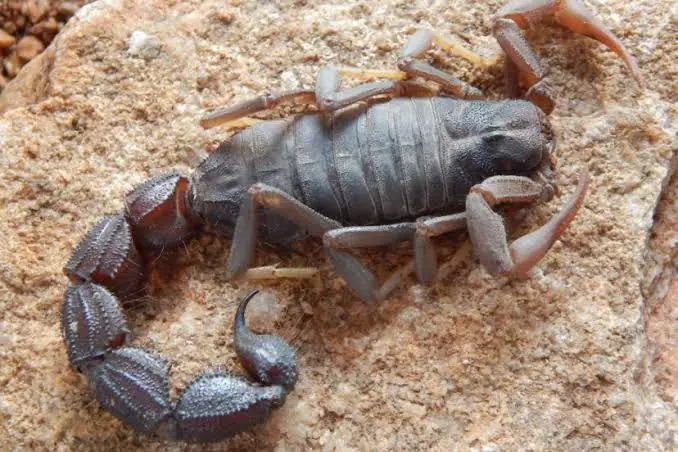
Scorpion control in Midrand means removing the cover scorpions shelter under and treating the perimeter they cross to get indoors. We inspect rockeries, rubble, paving edges and wall cracks, apply a residual barrier around the house and outbuildings, and show you how to seal the gaps under doors where scorpions walk in at night.
Why scorpions turn up in new Midrand homes
Scorpions have always lived in the rocky, grassy ground around Midrand. What changed is the building. Every new estate, complex and extension disturbs the soil and the rocks, and scorpions that lost their shelter move to the nearest dark gap. Often that is the rubble pile left behind the boundary wall, the stack of leftover paving bricks next to the garage, or the brand-new rockery by the front door. Homes on the edge of open veld and plots with old stone walls and outbuildings see them most.
They are active on warm nights from spring through summer, and especially after rain, when their prey (crickets, beetles and other insects) is everywhere. In winter they shelter deep in cracks and under stones, and people are surprised to find one under a pot plant they lift in July.
Which scorpion is dangerous?
The rule of thumb South Africans learn is a good one: thick tail, small pincers, be careful. Scorpions with a heavy, thick tail and slender pincers rely on venom, and some can give a dangerous sting, especially to children, the elderly and people with health problems. Scorpions with big, strong pincers and a thin tail rely on grabbing their prey, and their stings are usually painful but much less serious. Either way, treat every scorpion with respect, and if someone is stung by a thick-tailed scorpion, or feels symptoms beyond local pain, get medical help straight away.
Where we find scorpions on Midrand properties
- Under building rubble, leftover bricks, paving slabs and timber stacked in the garden.
- Inside rockeries, dry-stone walls and between boulders on the stand.
- Under pot plants, garden ornaments and doormats.
- In cracks along the base of boundary walls, garden steps and pool surrounds.
- Inside the house: in shoes, under towels on the bathroom floor, in garages and behind cupboards on ground level.
How we deal with them
Inspection, often at dusk
Scorpions glow under ultraviolet light, which makes it easier to see how many there are and where they are coming from. We look at the garden, walls, outbuildings and the edges of the house to find the main shelter areas.
Removing shelter
We point out rubble, stacked materials and debris that need to go. Treatment alone works far better once the main hiding places are gone.
Perimeter and harbourage treatment
An odourless, non-staining residual product goes around the outside of the house, along the base of walls, around doors and garages, into wall cracks and around rockeries. Scorpions walking across the treated band pick up the product.
Sealing entry points
Brush strips or rubber seals under doors, sealing gaps around pipes and weep holes, and keeping garage doors closed at night all make a big difference.
The mistake that keeps them coming
Treating the house and leaving the rubble pile. As long as there is a large, undisturbed shelter on the property, scorpions keep breeding there and keep wandering across. The other mistake is building a decorative rockery right against the house walls on a new stand, which gives scorpions a home on your doorstep.
A Midrand tip
When the builders leave, ask them to take the rubble with them. If it is already there, wear thick gloves and boots, use a spade rather than your hands, and clear it on a cool morning when scorpions are less active.
What scorpion control costs, and why
Most of a scorpion quote comes down to ground: the size of the property, how much perimeter needs treating, the number of outbuildings, rockeries and walls, and whether there is a lot of harbourage to deal with. A townhouse with a small garden is a quick job; a large stand or plot with stone walls takes longer. See our guide prices in Johannesburg for a starting figure, and the "from" price shown on this page. If you have seen one thin-tailed scorpion once in a year, removing its likely shelter may be all you need.
Plots and larger stands in the Kyalami area see more scorpions than most. Rockeries hide spiders as well, which our page on Midrand spider control covers. We handle the same problem with scorpion control in Fourways, and you can read about scorpions across Johannesburg or go to the Midrand hub.
Combat Pest Control is SAPCA registered and also registered with the Department of Agriculture under Act 36. Our owner and operator, Jason van Heerden, has 25 years of experience, we offer service within 24 hours, and scorpion treatments carry a 3-month guarantee. Call 084 200 2700, or WhatsApp us a clear photo of the scorpion and we will tell you what type it is.
Questions we get asked
How much does scorpion control cost?
It depends on the property size, the perimeter to treat, and how many rockeries, walls and outbuildings there are. A townhouse costs much less than a large plot. We quote after an inspection.
How do I know if a scorpion is dangerous?
Look at the tail and pincers. A thick tail with small pincers means more potent venom; a thin tail with big pincers usually means a less serious sting. Get medical help for any sting from a thick-tailed scorpion.
Why do I see more scorpions after rain?
Rain brings out the insects scorpions eat and floods some of their shelters, so they move around more on warm, wet nights.
Is the treatment safe for children and pets?
Yes, when it is applied correctly. Keep children and pets off treated areas until they are dry. The treatment goes mainly around the outside of the house.
Will scorpions still come into the house after treatment?
Far fewer should, especially once shelter is removed and gaps under doors are sealed. An occasional one may still wander in, which the treated band helps deal with.
What should I do before you arrive?
Do not move rubble or rocks with bare hands. Note where you have seen scorpions, and leave the garden as it is so we can find their shelter.