
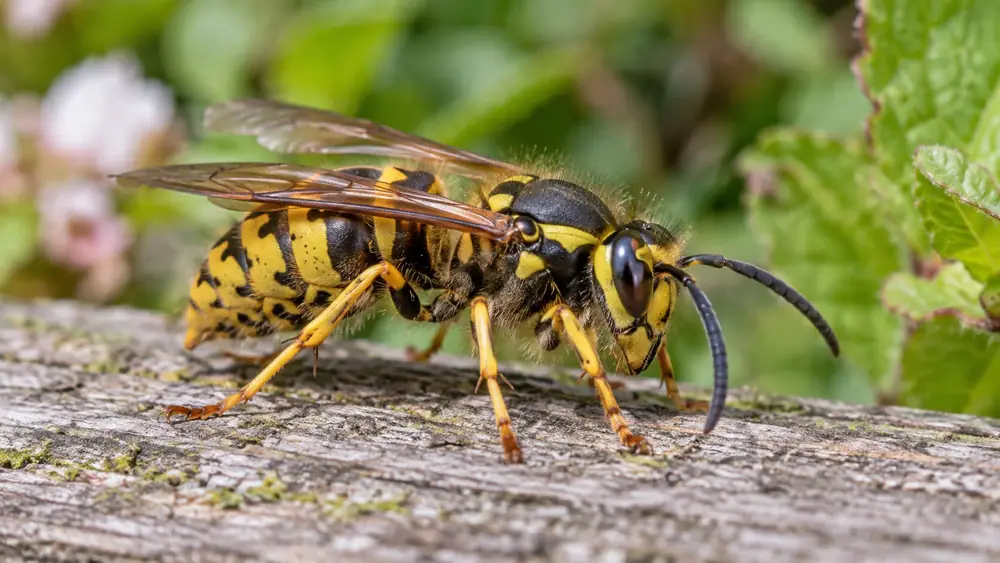
Wasp control in Fourways means treating the nest itself, not just the wasps flying around it. We find every active nest on the property, treat it with a targeted product so the adults and developing young are killed, then remove it. Most homes are dealt with in a single visit.
The wasps we deal with in Fourways
Most calls are about paper wasps. They're slender, with long legs that dangle in flight, usually yellow-and-brown or reddish, and they build open, grey, papery nests shaped like an upside-down umbrella or a small honeycomb on a stalk. A nest starts in spring with a single queen and a few cells, and by late summer it can be the size of a hand, with dozens of wasps defending it.
We also see mud daubers, which build small tubes or lumps of mud on walls, in garages and inside the folds of curtains or umbrellas. They're solitary, rarely sting and hunt spiders to stock their nests. Unless they're in a nuisance spot, they can often be left alone.
Why Fourways homes attract so many nests
Paper wasps want a sheltered spot, out of the rain and the hottest sun, close to water and insect prey. Fourways homes provide that in abundance. Wide roof overhangs, covered patios, pergolas, lapas, carports, balconies and the undersides of outdoor furniture all give shelter. Pools, water features and irrigation provide water. And estate gardens bordering veld supply plenty of caterpillars and other insects that wasps catch to feed their young.
Some favourite spots on Fourways properties:
- Under the eaves and fascia boards, especially on the shaded side of the house
- Inside the roof of a covered patio, carport or pergola
- Inside gate motor covers, electricity meter boxes and pool pump housings
- Under outdoor tables, loungers and the lip of a braai area
- In wendy houses, garden sheds and children's play equipment
When a nest becomes a problem
A small nest high up on a wall that nobody walks past may be tolerable. But wasps defend their nest hard, and a nest next to a door, a gate motor, the pool or a play area will eventually lead to stings. For anyone with a known allergy to wasp or bee stings, even one nest near the house is a real risk, and it should be removed quickly. Signs of a serious reaction, such as swelling of the face or throat, difficulty breathing or dizziness, need emergency medical help.
How we treat wasp nests
- Find all the nests. Where there's one, there are often others. We check the eaves, patio, outbuildings, gate motor, meter box and outdoor furniture.
- Treat the nest. We use a targeted product applied directly onto and into the nest, working from a safe distance with the right protective gear. Where possible we time it for early morning or late afternoon, when the wasps are on the nest and calmer.
- Remove it. Once the wasps are dead, the nest is taken down, so it can't be reused and you don't have a cluster of hatching young left behind.
- Treat the surroundings if needed. In spots where wasps keep rebuilding, a residual treatment on the surface discourages new queens.
You don't need to leave home, but keep children and pets indoors while we work and away from treated areas until they're dry.
The risky DIY move
Knocking the nest down with a broom or spraying it with a hose. The wasps don't leave; they attack, and the person holding the broom is the obvious target. Spraying from below with a household can, especially in the middle of a hot day, has the same result. If you must deal with a tiny nest of two or three wasps in early spring, do it at dusk from a distance, but anything bigger is a job for us.
Is it wasps or bees?
Bees are hairier and stockier, and they live in enclosed cavities like walls, roofs, meter boxes and tree hollows rather than on open paper combs. Bees are handled differently, and where possible with a beekeeper, so see bee control in Fourways if what you're seeing is a swarm or bees going in and out of a hole.
A Fourways prevention tip
Walk around the house once a month from September to November with a torch and check under the eaves, the patio roof, the gate motor cover and outdoor furniture. Spring nests are tiny, with just a queen and a few cells, and they're far easier to deal with than a nest that's been left until February.
What wasp control costs, and why
The price is set by the number of nests, how high or hard to reach they are, and whether they're inside something like a roof void, gate motor or meter box that has to be opened. A single nest under a patio roof is a small job. Several nests on a double-storey, or one inside a wall cavity, take longer. See the starting prices in our Johannesburg price list.
For more on species and stings, see wasp control in Johannesburg. We also remove wasp nests in Midrand, deal with homes in Witkoppen, and cover the rest of the area through our Fourways pest control page.
Combat Pest Control is SAPCA registered, registered with the Department of Agriculture and run by Jason van Heerden, who has 25 years in the industry. We offer service within 24 hours, and if treated wasps return to the same spot within 3 months, we come back. Phone 084 200 2700, or WhatsApp a photo of the nest from a safe distance.
Questions we get asked
How much does wasp nest removal cost?
It depends on the number of nests and how hard they are to reach. A single nest under a patio roof is a small job; several nests on a double-storey or inside a cavity cost more.
Can I remove a wasp nest myself?
Only a tiny spring nest with two or three wasps, at dusk and from a distance. Larger nests should be left to us, because wasps defend them aggressively.
Will the wasps come back to the same spot?
Sometimes, because the shelter is still attractive. Removing the old nest and treating the surface helps, and checking in spring catches new nests early.
Is it safe for my children and dogs?
Yes, as long as they stay indoors while we treat the nest and keep away from treated areas until dry.
When are wasps worst in Fourways?
Nests start in spring and grow through summer, so late summer is when they're biggest and most defensive. Spring is the easiest time to deal with them.
Do you remove wasp nests from gate motors and meter boxes?
Yes, those are common spots. We treat the nest inside the housing, then remove it once the wasps are dead.
What should I do if I'm stung?
Move away from the nest, wash the sting and use a cold compress. If there's swelling of the face or throat, difficulty breathing or dizziness, get emergency help immediately.