
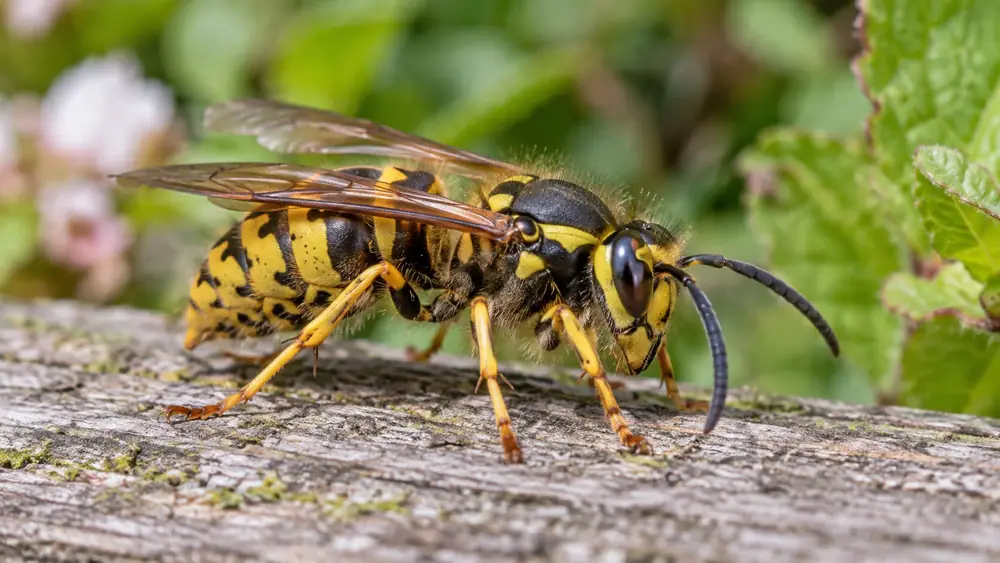
Wasp control in Johannesburg means finding every nest on the property, treating each one so the colony dies inside it, and then taking the comb down so a new queen doesn't build in the same spot. Most calls are paper wasps under eaves, patio roofs and window frames, and one visit late in the day usually settles it.
Which wasps you are likely to meet
The wasp most households know is the paper wasp: slim, yellow and brown or yellow and black, with long legs that hang down in flight. It builds an open, umbrella-shaped comb of grey paper on a single stalk, with the cells visible from underneath. A nest starts in spring with one queen and grows all summer, so the coin-sized comb you ignored in October can be as wide as your hand by February.
The other regular is the mud dauber, a dark wasp with a thread-thin waist that builds little tubes and pots of mud on walls, in garages and under stoep furniture. Mud daubers live alone and very seldom sting anyone. They are more of a cleaning job than a pest problem, and if that's all you have, we'll tell you.
Why the calls come in summer
Highveld summers suit wasps. Warm days arrive in September, the afternoon storms keep gardens full of the caterpillars and flies that wasps hunt to feed their young, and houses offer plenty of dry, sheltered places to build. By late summer the nests are at their largest and the wasps are at their most defensive. That's when most stings happen, nearly always because someone trimmed a hedge or opened a shutter without spotting the nest first.
Where we find nests
- Under eaves and fascia boards, especially on the side of the house out of the wind
- Inside roof spaces, with the wasps using a lifted tile or a broken vent as a door
- Beneath pergolas, carports and patio covers
- Behind shutters, burglar bars and windows that are rarely opened
- Deep in hedges, creepers and shrubs, often right at hand height
- Inside pool pump covers, meter boxes, garden sheds and folded umbrellas
How we deal with a nest
We walk the whole property first, because one nest is often a sign of two or three more. The treatment goes directly onto and into each nest with a registered product, preferably in the late afternoon when the foragers have come home. Once the colony is dead we take the comb down and, if you'd like, treat the surrounding surface with a residual product that discourages a queen from starting again there next spring. A nest hidden inside a roof void or wall cavity is treated through its entrance hole, and if part of it can't be reached we'll explain why it's safe to leave it to dry out.
Nobody needs to leave the house. Keep children and pets inside while we work and until the treated area has dried.
Homes, schools and businesses
At home, the worry is usually a nest beside a door, the pool or a bedroom window. Schools, crèches and restaurants with outdoor tables need fewer stings in places full of people, so we can book checks before and during the season and keep a written note of what was treated. Estates and complexes often find nests on guardhouses, clubhouses and other common-property buildings, and it's cheaper to clear those in one visit than one by one.
The mistake that gets people stung
Knocking a nest down with a broom, or hosing it off in the middle of the day, is the classic error. The foragers that were out come back to find their comb gone, and they either rebuild a metre away or hang around in a bad mood for days. Spraying a supermarket can from the top of a ladder is not much better: you're within striking distance, on unsteady footing, inside a cloud of wasps. If anyone in the household is allergic to stings, please don't attempt it at all.
A Johannesburg tip
Do a slow walk around the house in early spring and look up under the eaves, the patio roof and the carport. A starter nest at that stage is a small cluster of cells with a single queen on it, and it is far easier to deal with than the colony it turns into by Christmas.
What it costs and why
Wasp work is priced on what we find: how many nests there are, how high they sit, whether they're in the open or tucked inside a roof or wall, and whether you want a residual treatment to discourage rebuilding. One reachable nest under an eave is a small job. A school campus, or an estate with nests on several buildings, takes longer. Our pest control price guide shows the "from" price for wasp nests, and we'll confirm the figure once you've described the nest or sent a photo.
Wasps across the city
Big gardens and estates in the north produce plenty of nests, so we have pages for wasp nest removal in Fourways and wasp control in Northcliff, and the deep eaves of older southern homes keep our Johannesburg South wasp service busy. If the insects are furry and arrive as a humming cloud, it's more likely a swarm, so see bee control in Johannesburg. To understand how a colony grows and dies over one season, read the wasp guide.
Combat Pest Control is owned and run by Jason van Heerden, SAPCA registered and registered with the Department of Agriculture under Act 36 of 1947, with 25 years in pest control. We offer service within 24 hours, and the treatment carries a 3-month guarantee. Call 084 200 2700, or WhatsApp us a photo of the nest and where it hangs.
Questions we get asked
How much does it cost to remove a wasp nest?
It depends mainly on how many nests there are and how hard they are to reach. A single open nest under an eave is a small job; nests inside a roof, or several on one property, take longer. Our price guide shows the starting price, and a photo lets us confirm it.
Will the wasps come back once the nest is gone?
Not to that nest. A new queen may try a similar sheltered spot next spring, which is why we can treat the surface around it. If the treated wasps return within 3 months, we come back.
Can I deal with a small nest myself?
Sometimes. A tiny starter nest at shoulder height, away from doors, with nobody allergic in the house, is a reasonable DIY job at dusk. Anything larger, higher or inside the roof is worth a professional visit.
Is the treatment safe for my children and dogs?
Yes, if they stay indoors while we work and keep away from the treated area until it has dried. We treat the nest itself rather than spraying the garden.
Why do you prefer to treat wasps late in the day?
Because that's when the foragers are back on the nest. Treating at midday leaves part of the colony out hunting, and those wasps return to an empty spot.
Do mud daubers need treatment?
Usually not. They are solitary, rarely sting and do no harm beyond the mess. Scraping off the mud nests is normally enough.
What should I do before you arrive?
Keep people and pets away from the nest, don't knock it or spray it, and note where you see wasps flying in and out. That flight path often leads us to a second nest.