
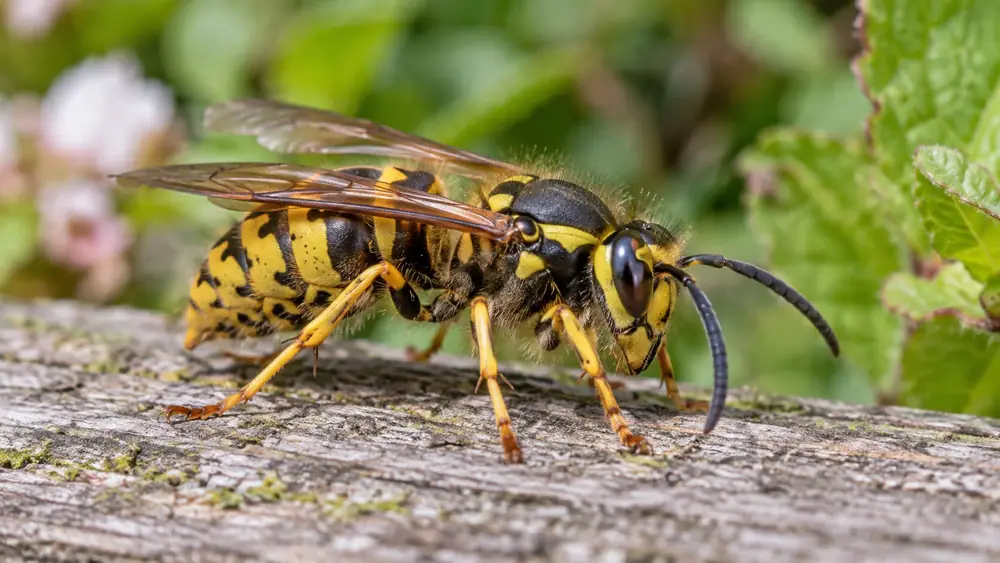
Wasp control in Randburg means treating and removing the nest, not swatting the wasps that fly around it. We find every nest on the property, including the hidden ones in roofs, gate motor housings and sheds, treat them with a targeted product and remove them where they can be reached, so the colony doesn't rebuild in the same spot.
The wasps behind most calls
Paper wasps
Slender, yellow-and-brown or reddish wasps with long dangling legs in flight. They build open, umbrella-shaped grey paper nests with the cells showing, hanging from a short stalk. Typical spots are under eaves, beneath roof overhangs, inside carports, on security gates, inside gate motor boxes, in light fittings and under outdoor furniture. They sting to defend the nest, and walking past or brushing against it is usually what sets them off.
Mud daubers and potter wasps
Solitary wasps that build small mud cells or pots on walls, window frames, behind shutters and in garages. They rarely sting people and don't defend nests in swarms, but the mud nests are unsightly and stain walls.
Is it a wasp or a bee?
Honeybees are hairier, browner and stockier and build wax comb, usually inside a cavity. If what you have is a swarm or wax comb in a wall or roof, see our page on bees in Randburg properties, because bees are handled differently.
Why Randburg properties get so many nests
Wasps follow warm summers and plenty of insects to feed their young. Randburg's established gardens, big trees and flowering shrubs supply both. Older houses with deep eaves, timber fascias, pergolas and covered stoeps give paper wasps the sheltered overhangs they prefer, and almost every property has a gate motor, a meter box or a carport roof. Nests start small in spring, with a single queen, and grow through summer. By late summer a nest that was the size of a coin in October can hold dozens of wasps.
How we deal with wasp nests
- We survey the property for every active nest, not only the one you've spotted. It's common to find several on the same house.
- We treat the nest directly with a targeted product, using protective gear and timing that suits the situation, so the wasps returning to it are also affected.
- We remove the nest where it can be safely reached, which discourages wasps from rebuilding in the same place.
- We treat nearby resting spots if needed, such as the underside of eaves where new queens may try to start again.
You don't need to leave home, but keep children and pets indoors or well away while we work.
When it's urgent
A nest next to a door, a play area, a pool or a gate you use every day is worth dealing with straight away, especially if anyone in the house is allergic to stings. Anyone stung who has trouble breathing, swelling of the face or throat, or feels faint needs emergency medical help immediately. For schools, crèches and complexes with shared walkways, we prioritise nests near entrances and play areas.
The common mistake
Knocking the nest down with a broom or hosing it at midday. The wasps are all active, they defend the nest and people get stung. Spraying a large nest with a weak can from the shop often has the same result. If the nest is bigger than a golf ball or out of easy reach, leave it to us.
A Randburg tip
Check the eaves, carport, pergola and gate motor box in early spring, around September, when nests are tiny and being started by a single queen. A nest the size of a coin can be dealt with far more easily than a full colony in February. Keeping the gate motor cover properly closed stops it becoming a favourite nest site.
What wasp control costs, and why
The price depends on how many nests there are, how high and hard to reach they are, whether a nest is inside a roof or a cavity rather than out in the open, and the size of the property. One nest under a low eave is a quick job; several nests high on a double-storey or inside a roof take longer. The guide "from" price on this page also appears in our Johannesburg pest control prices, and we confirm it before treating. A single, small mud dauber nest can be scraped off with a paint scraper.
For more on wasp species across the city, see wasp control in Johannesburg. We also remove wasp nests in Northcliff, and Craighall has its own local page. The full list of what we do in the area is on Randburg pest control.
We're SAPCA registered and registered with the Department of Agriculture, and owner Jason van Heerden has 25 years of experience. Service within 24 hours, and wasp treatments carry a 3-month guarantee. Call 084 200 2700, or WhatsApp us a photo of the nest from a safe distance.
Questions we get asked
How much does it cost to remove a wasp nest?
It depends on the number of nests and how hard they are to reach. One low nest under the eaves is a quick, affordable job; several high or hidden nests take longer. We confirm the price before we start.
Can I remove a wasp nest myself?
A tiny nest the size of a coin in early spring, maybe, with care and at dusk. Anything larger, high up or inside a roof or gate motor box is best left to us, because the wasps will defend it.
Will the wasps come back to the same spot?
Wasps often return to sheltered spots they've used before. Removing the old nest and treating the surrounding surface makes it much less likely, and the treatment carries a 3-month guarantee.
Is the treatment safe for my children and dogs?
Yes, as long as they stay away while we work and off treated surfaces until dry. We treat the nest directly rather than spraying the whole garden.
Do you remove nests inside the roof?
Yes. If wasps are flying in and out of roof tiles or a gap in the fascia, the nest is inside, and we treat it where it is and remove it where it can be reached.
What should I do if I'm stung?
Remove yourself from the area, wash the sting and use a cold compress. If you have trouble breathing, swelling of the face or throat, or feel faint, get emergency medical help immediately.