
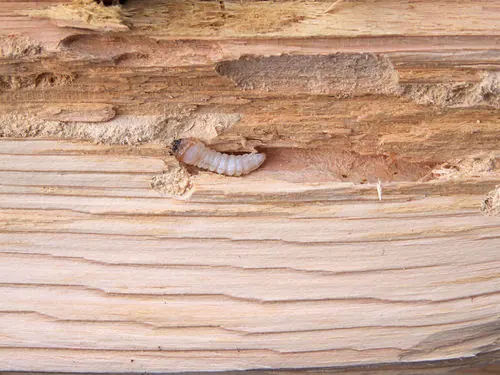
Wood borer treatment in Sandton starts with confirming the beetle is still active, then treating the affected timber so larvae inside it die and new eggs aren't laid. We inspect floors, roof timbers, furniture and outdoor structures, treat the wood directly, and arrange fumigation with registered fumigants for items that can't be treated any other way.
What wood borer is
Wood borer is the name for several beetles whose larvae live inside timber and eat it for months or years before emerging as adults. The adults bore out through the surface, leaving the small round exit holes people notice, then mate and lay eggs on the same or nearby timber. By the time you see holes, the larvae have often been working inside for a long time. The most common culprits in Johannesburg homes attack softwoods such as pine floorboards, skirting and roof trusses, while others prefer hardwoods, cane and bamboo furniture.
Why Sandton homes get wood borer
Sandton has a mix of older family homes, many with pine floors, timber ceilings and roof trusses that have been in place for decades, and newer houses with a lot of decorative timber. Wood borer affects both. In older homes, it's often found in the roof space and under suspended floors, where the timber is undisturbed and never treated. In newer homes, it comes in with timber furniture, wooden decor, antiques or second-hand pieces, or with untreated poles used for lapas, pergolas and carports. Thatched lapas, common in northern suburbs gardens, are worth checking: the poles and battens are a regular source.
Signs of active wood borer
- Small, round exit holes in timber, usually a few millimetres across
- Fine, pale powder (frass) under the holes or on the floor below furniture or beams
- Fresh-looking holes with clean, light edges, compared to old holes that have darkened
- Small beetles near windows in spring and summer, when adults emerge
- Soft, crumbling timber in badly affected areas
Old holes alone don't mean the beetle is still active. Fresh frass and new holes do.
Wood borer or termites?
Both damage timber, but the signs are very different. Wood borer leaves small round exit holes and fine powdery dust. Subterranean termites leave mud tubes, mud-packed galleries and hollow timber, with no neat exit holes. The treatment is completely different too, so getting it right matters. If you're seeing mud tubes, see termite control for Sandton homes instead, where termite work carries a 5-year guarantee with a treatment certificate.
How we treat wood borer
- Inspection. We check floors, skirting, roof timbers, ceilings, doors, furniture and outdoor timber, and confirm whether the activity is current.
- Surface treatment of the timber. A registered wood borer treatment is applied to the affected and surrounding timber, soaking in to reach larvae and to stop new eggs being laid on the surface.
- Injection into exit holes or treatment of hard-to-reach areas where needed.
- Fumigation with registered fumigants for furniture, antiques and other items that can't be treated by surface application. The sealed area must be empty until it's cleared.
- Advice on repairs. Badly damaged timber may need replacing by a carpenter after treatment.
Surface treatments don't require you to leave home; keep children and pets off treated timber until it's dry.
The mistake that wastes money
Sanding and varnishing a floor with active wood borer. The finish seals the surface and looks lovely, but the larvae carry on eating inside and emerge through the new varnish a season or two later. Treatment first, then sanding and sealing, is the right order.
A Sandton tip
Before you buy antique or second-hand timber furniture, or reuse old timber in a renovation, check it underneath and inside drawers for fresh powder and holes. Many Sandton wood borer cases we see started with one beautiful old piece that brought the beetles in with it.
What wood borer treatment costs, and why
The price depends on how much timber is affected, where it is, such as a floor, a roof space or a single piece of furniture, and whether fumigation is needed. A cabinet or a small area of floor is a modest job; a full roof space or a whole house of pine floors takes more time and product. This page shows a guide 'from' price, and our pest control price guide for Johannesburg gives the details. If the holes are old and dark with no fresh dust, you may not need treatment at all, and we'll tell you.
For the bigger picture of wood borer across the city, see wood borer treatment in Johannesburg. All our local services are on our Sandton pest control page, and there's a dedicated Bramley pest control page too. Next door, we also treat wood borer in Bryanston homes.
Combat Pest Control has 25 years of experience, is SAPCA registered and registered with the Department of Agriculture, and is run by Jason van Heerden. We offer service within 24 hours, and wood borer treatments carry a 3-month guarantee. Call 084 200 2700, or WhatsApp us a photo of the holes and the dust.

Questions we get asked
How much does wood borer treatment cost?
It depends on how much timber is affected and where. A single piece of furniture or small floor area is modest; a full roof space or large floor area takes more time. Fumigation is priced separately.
How do I know if the wood borer is still active?
Look for fresh, pale powder under the holes and new holes with clean edges. Old, dark holes with no fresh dust usually mean the infestation has stopped.
Can wood borer spread to other furniture?
Yes. Adult beetles lay eggs on nearby timber, so an infested piece can spread the problem. Treating or isolating it quickly helps.
Do I need to move out for wood borer treatment?
Not for surface treatment of floors or roof timbers. Keep children and pets off treated timber until it's dry. Fumigation needs the sealed area to be empty until it's cleared.
Is it wood borer or termites?
Wood borer leaves small round exit holes and fine powdery dust. Termites leave mud tubes and hollow timber. The treatments are completely different, so we confirm first.
Do I need to replace damaged timber?
Only if it's structurally weakened. Many floors and beams just need treating; badly damaged timber may need a carpenter after treatment.