
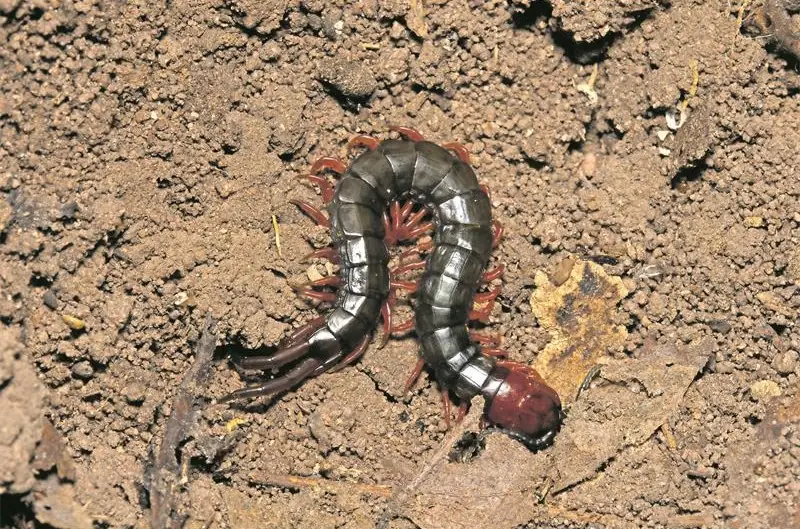
Centipede control in Bryanston means reducing their numbers in the garden beds near the house and blocking the routes into bathrooms, garages and storerooms. We treat moist harbourage, leaf litter and the house perimeter with an odourless residual product, and advise on the damp, cluttered spots that keep centipedes close to your home.
What centipedes are, and why they bite
Centipedes are fast, flattened predators with one pair of legs per body segment and a pair of venomous claws just behind the head. They hunt insects, spiders, worms and other small creatures, mostly at night, and they need moisture to survive. Most of the small ones are harmless to people. The larger garden centipedes, which can be as long as a finger and are often orange, yellow or dark green, can give a sharp, painful bite if handled or trapped against skin.
Don't confuse them with millipedes. Millipedes are slow, rounded and curl up when disturbed, with two pairs of legs per segment; they eat dead plant material and don't bite. Centipedes run.
Why Bryanston has plenty
Centipedes love the same things Bryanston gardens are full of: deep layers of leaf litter under old trees, mulched beds kept moist by irrigation, rockeries, timber edging, loose paving and garden refuse piles. Each of those holds moisture and prey. After heavy summer rain, flooding of their hiding places pushes centipedes out across paving and into houses, which is when most people first notice them.
Inside, they look for damp: bathrooms, laundries, sculleries, basements on sloping stands and garages with a leaking tap. They hunt fish moths, small cockroaches and spiders, so a centipede problem indoors often points to another insect problem as well.
Signs of a centipede problem
- Centipedes seen in the bath, shower or laundry at night
- Large centipedes under pots, stones and timber in the garden
- Repeated sightings in a garage, basement or storeroom
- Other insects such as fish moths or cockroaches in the same rooms
How we treat centipedes
Inspection. We look for moist harbourage close to the house: beds against walls, leaf litter, drains, damp corners and gaps under doors.
Garden and perimeter. An odourless, non-staining residual product is applied to the beds and leaf litter near the walls, paving edges and rockeries, then around the foundations, door thresholds and weep holes.
Inside. Damp rooms, under baths and sinks, garage corners and storerooms are treated where needed.
Food supply. If we find fish moths, cockroaches or spiders feeding the centipedes, we treat those too.
Once surfaces have dried, children and pets can use the area again as normal.
Garages, basements and outbuildings
On many Bryanston properties the centipedes we find indoors aren't in the house at all, but in the spaces around it. A basement or lower-level room on a sloping stand, a double garage with a floor drain, a store room behind the pool pump and staff quarters with an outside shower all stay damp and quiet. Those rooms are worth including in the treatment, and a simple fix such as sealing the gap under a garage side door often makes a noticeable difference.
Before we arrive
Tell us where and when you see the centipedes, clear the floor of any damp room we will be treating and switch off the irrigation for a day so beds near the house aren't waterlogged during treatment.
Where people go wrong
Drowning the beds against the house. Irrigation running every evening in summer keeps soil and mulch soaking wet right up against the walls, which is perfect centipede habitat. Spraying inside without dealing with that just means more centipedes arrive the following week.
A Bryanston tip
Pull mulch and leaf litter back about half a metre from the house walls and replace it with gravel or bare soil along that strip. On stands with big trees, sweep the leaves off the paving next to the house once a week in autumn. It cuts centipede numbers near the doors dramatically, and helps with millipedes and scorpions too.
If you are bitten
Wash the bite, apply a cold compress and take a mild painkiller if needed. The pain usually fades within hours. Get medical advice if there is swelling that spreads, signs of infection, or an allergic reaction, and take extra care with children.
What centipede control costs, and why
The cost depends on the size of the property, how much of the garden near the house needs treating, the number of damp rooms and outbuildings involved and whether other insects need treating at the same time. A cluster unit is quick. A large stand with deep beds, rockeries and a basement takes longer. The guide "from" price on this page and our Johannesburg pricing page give you an idea before we visit. If you see one centipede in the bath once a summer, fixing the damp and clearing the mulch from the walls is probably enough.
Millipedes usually turn up at the same time of year; our millipede control in Bryanston explains how we deal with them. We also treat centipedes in Sandton homes, gardens in Magaliessig, and properties everywhere through centipede control in Johannesburg. The Bryanston area page covers our other local work.
Jason van Heerden runs Combat Pest Control, with 25 years of experience, SAPCA registration and registration with the Department of Agriculture. We offer service within 24 hours, and centipede treatments have a 3-month guarantee. Call 084 200 2700, or WhatsApp us a photo.
Questions we get asked
How much does centipede control cost?
It depends on the size of the property, how much of the garden near the house needs treating and how many damp rooms are involved. We confirm the price after a quick look.
Are centipedes dangerous?
Most are harmless. Large garden centipedes can give a painful bite, but it is rarely serious. Get medical advice for spreading swelling, infection or an allergic reaction.
Why do I find centipedes in the bath?
They are drawn to moisture and fall into smooth baths and basins, then can't climb out. Damp bathrooms and gaps around pipes bring them in.
Is the treatment safe for children and pets?
Yes. Keep children and pets away from treated areas until the surfaces have dried.
How do I tell a centipede from a millipede?
Centipedes are fast, flat and have one pair of legs per segment. Millipedes are slow, round, have two pairs per segment and curl up when touched.
When are centipedes most active?
At night and after heavy summer rain, when water floods their hiding places in the garden.