
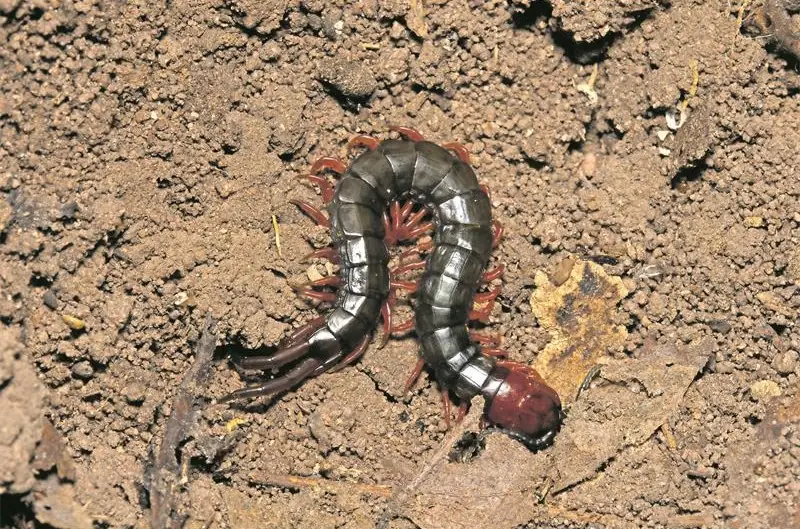
Centipede control in Midrand is mostly about damp and shelter. Centipedes come in from flowerbeds, mulch, compost and paving when summer rain soaks the ground, then hide in bathrooms, garages and under kitchen units. We treat the perimeter and the damp spots they use, and help you take away the conditions that draw them in.
Midrand's centipede season
Centipedes are hunters. They feed on small insects, spiders and worms, and they need moisture to survive. For most of the dry Highveld winter you hardly see them. Then the summer storms arrive, the soil fills up with water, and centipedes leave the flooded ground to look for shelter and food. In the following weeks they turn up on bathroom floors, in shower trays, under bath mats, in the garage and occasionally in shoes left by the door.
Many Midrand homes have features that make this worse: deep flowerbeds and bark mulch right against the walls, irrigation that runs every evening, pot plants on the patio, and paving laid on sand that stays damp underneath. In denser parts of Midrand, such as Ebony Park, centipedes shelter under building materials, stacked bricks and household items kept in yards.
Do centipedes bite?
Yes, some do. Larger garden centipedes can give a painful bite when handled or trapped against skin, for example when someone puts on a boot or picks up a towel from the floor. For most people the bite causes local pain and swelling that settles down, but children, people with allergies, or anyone with a strong reaction should see a doctor. Smaller house centipedes are much less of a concern, though they unsettle a lot of people with their speed and long legs.
Telling centipedes from millipedes
People mix them up all the time. Centipedes are flattened, fast and have one pair of legs per body segment, with a pair of pincer-like fangs behind the head. They hunt and can bite. Millipedes (shongololos) are rounder, slow, and have two pairs of legs per segment. They eat decaying plants, do not bite, and curl up when disturbed. If you are seeing lots of slow, curled-up creatures on the walls after rain, our page on millipedes in Midrand homes is the one to read.
Where centipedes hide
- Under pot plants, paving slabs, stones and garden edging.
- In compost, bark mulch and leaf litter close to the house.
- In floor drains, under baths and in damp corners of bathrooms and laundries.
- In garages among stored boxes, shoes and garden equipment.
- Under kitchen kick plates and inside the gaps at the base of built-in cupboards.
How we treat centipedes
We inspect the outside of the house first, because that is where centipedes live, then check bathrooms, laundries, garages and kitchens for damp areas and entry points. An odourless, non-staining residual treatment goes around the perimeter of the house, along the base of walls, around doors and weep holes, and into damp shelter spots outside. Inside, we treat the bathroom, laundry and garage corners and any voids where they are found. You can stay in the house; keep children and animals off treated surfaces until dry.
The most common mistake
Chasing centipedes around the house with a spray can while the flowerbed against the wall stays soaked and covered in thick mulch. As long as there is damp shelter right next to the house, centipedes keep coming in. Fixing the outside conditions does more than any amount of spraying indoors.
A Midrand tip
Pull mulch back about 30 centimetres from the walls of the house and move pot plants onto stands so the ground underneath can dry. Set the irrigation to water early in the morning rather than in the evening, so the soil next to the house is drier at night when centipedes are active.
Homes, schools and businesses
Centipedes in a classroom, an office bathroom or a restaurant storeroom cause more alarm than in a home. For schools and businesses we can include centipedes in a scheduled crawling insect treatment, timed for the start of the rainy season.
What centipede control costs, and why
Centipede work is mostly outside, so the quote follows the stand size, the length of the perimeter, how much of the garden needs treating and whether the inside needs attention too. A townhouse is a small job; a large house with deep beds and outbuildings takes more time. Our pest control price list shows the starting point, and this page carries a guide "from" price. If you see one or two after a big storm, reducing mulch and fixing damp may be enough without treatment.
For the same work in the south, see our centipede control in Sandton, read the wider guide to centipede control across Johannesburg, or browse the other pests on our Midrand pest control page.
Combat Pest Control is registered with SAPCA and the Department of Agriculture under Act 36, and owner Jason van Heerden brings 25 years of pest control experience to the job. Book and you get service within 24 hours, with a 3-month guarantee on the treatment. Call 084 200 2700, or WhatsApp us a photo so we can tell you whether it is a centipede or a millipede.
Questions we get asked
How much does centipede treatment cost?
It depends on the property size, the perimeter length and how much of the garden and house need treating. A townhouse is much cheaper than a large property with deep flowerbeds. We quote before treating.
Are centipedes dangerous?
Larger ones can give a painful bite, especially if trapped against skin. Most bites settle with time, but see a doctor if there is a strong reaction, or if a child is bitten.
Why are there centipedes in my bathroom?
Bathrooms are damp and often connect to the outside through drains and gaps. Centipedes come in looking for moisture and insects to eat.
Is the treatment safe for my family?
Yes. Keep children and pets off treated surfaces until they have dried, then use the rooms normally. Most of the treatment goes around the outside.
When do centipedes come out most?
In the warm, wet summer months, especially in the days after heavy rain soaks the ground.
How long will the treatment protect my home?
The residual treatment works for weeks to months depending on weather. Reducing damp and mulch near the walls keeps the results going longer, and our treatments carry a 3-month guarantee.