
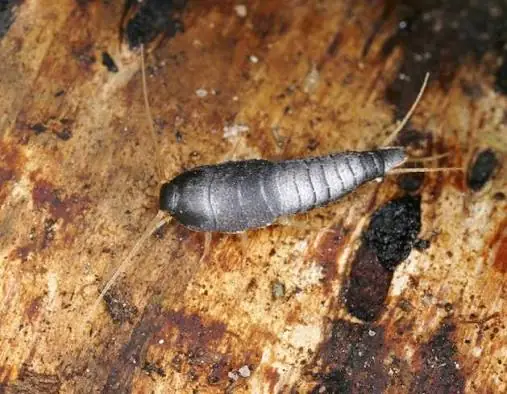
Fish moth control in Johannesburg starts with finding where they're breeding: usually a roof space, a built-in cupboard, a bookshelf or a storeroom full of paper and cardboard. We treat those harbourage areas with odourless, non-staining residual treatments and point out the dampness, clutter and food sources that let them build up.
What fish moths are
Fish moths, also called silverfish, aren't moths at all. They're small, wingless insects with a carrot-shaped silver body, three tail bristles and a fast, wriggling run that looks a bit like a fish swimming. They're active at night and hide by day in cracks, behind skirting boards, inside cupboards and in roof insulation.
They don't bite and they don't carry disease, but they do damage. Fish moths feed on starch, sugar and protein: the glue in book bindings, wallpaper paste, photographs, cardboard boxes, paper files, cotton and linen with sizing in it, and dry foods like flour and cereal. Over months they leave irregular holes, scraped surfaces and yellow stains on whatever they're feeding on.
Why Johannesburg homes have fish moths
Johannesburg is dry for half the year, but fish moths find their own damp corners. Bathrooms and kitchens with poor ventilation, cupboards on outside walls, under-sink cabinets and roof spaces beneath leaking sheeting all hold enough moisture. The summer rains raise humidity indoors, and activity tends to increase from October to March.
Older houses are especially prone. Heritage homes in the inner northern suburbs, with built-in wooden cupboards, pressed ceilings and roof spaces that haven't been disturbed in decades, can hold large populations. Our fish moth treatments in Rosebank deal with plenty of these older houses, and the established homes and flats in Randburg see a lot too.
Signs of fish moths
- Silver insects darting away when you move books, boxes or clothes
- Small irregular holes or scraped patches on paper, wallpaper and book covers
- Yellowish stains and tiny pepper-like droppings in cupboards and on shelves
- Shed scales or skins in drawers and boxes
- Fish moths in the bath or basin in the morning: they fall in and can't climb out
Where we find them breeding
When we inspect, the culprits are usually the same few places. Roof spaces with old insulation, dust and stored boxes. Built-in cupboards, especially the top shelves where suitcases and paper live. Bookshelves against outside walls. Garages and storerooms with cardboard, old magazines and files. Under-sink cupboards with a slow leak. Offices with archive rooms and stationery stores, and schools and libraries, can carry very large populations.
Fish moths or something else?
A few other small insects get mistaken for fish moths. Booklice are much smaller, pale and slow. Young cockroaches are darker, with long antennae and legs. Firebrats look very like fish moths but prefer hot spots, such as around geysers, ovens and boilers. Knowing which one it is matters, because the hiding places, and so the treatment, are different.
How we treat fish moths
- Inspection. We find the harbourage areas and the moisture and food sources behind them.
- Treatment of harbourage. We apply odourless, non-staining residual treatments into cracks, along skirting boards, inside cupboards and shelves, and where needed in the roof space, where fish moths spend the day.
- Advice. We show you what to change: ventilation, leaks, clutter and storage.
- Follow-up where needed. Large infestations, especially in roof spaces and archives, may need a second treatment.
Normal life goes on during treatment. Keep children and pets out of treated cupboards and off treated surfaces until they're dry, and put clothes and linen back once the shelves have dried.
What people often get wrong
Treating the bathroom because that's where they're seen. Fish moths in the bath have usually come from somewhere else, often the roof space or a nearby cupboard, and fallen in during the night. Treating only the bath doesn't touch the source. The other mistake is relying on mothballs or cedar: they're aimed at clothes moths and do very little against fish moths.
Prevention tips for Highveld homes
- Store papers, photos and seasonal clothes in sealed plastic boxes instead of cardboard.
- Fix leaking pipes under basins and the sink, and ventilate bathrooms after showers.
- Clear old boxes, magazines and newspapers out of the roof space and garage.
- Leave a small gap between bookshelves and outside walls.
- Store flour, cereal and pasta in sealed containers.
What fish moth control costs, and why
The price depends on how many rooms and cupboards are involved, whether the roof space needs treatment, and how much storage and clutter there is to work around. A few cupboards in a flat is a small job; a large old house with a full roof space, or an office archive, takes more time. Our price guide for Johannesburg shows the guide price for fish moth treatments. If you see one or two in the bathroom, fixing the ventilation and clearing clutter might be all that's needed. For more on their biology, read the fish moth guide. Tiny pale insects on damp books may be something else; see booklice treatment in Johannesburg.
Fish moth damage is slow but permanent, so it's worth acting before your books and photos suffer. Jason van Heerden brings 25 years in pest control, the business is registered with SAPCA and the Department of Agriculture, and fish moth treatments come with a 3-month guarantee and service within 24 hours. Phone 084 200 2700, or WhatsApp a picture of the insect or the damaged paper.
Questions we get asked
How much does fish moth treatment cost?
Fish moth treatment is usually a modest job, priced on the number of rooms and cupboards, whether the roof space needs treating and how much storage there is. A flat is a small job; a big old house or office archive takes longer. We confirm the price first.
Are fish moths harmful?
They don't bite or spread disease, but they damage books, papers, photos, wallpaper, clothing and dry food by feeding on starch and glue.
Why do I find fish moths in the bath?
They wander at night, fall into the bath or basin and can't climb the smooth sides. They usually come from cupboards or the roof space nearby.
Do I need to empty my cupboards before treatment?
For the cupboards being treated, yes. Take clothes, linen and papers out so we can treat the shelves, and put them back once the shelves are dry.
Do mothballs get rid of fish moths?
Not really. Mothballs and cedar are aimed at clothes moths and have little effect on fish moths. Treating the harbourage and reducing damp works much better.
How long does a fish moth treatment last?
The treatment carries a 3-month guarantee. Storing paper in sealed boxes and fixing damp spots stops them building up again.
Can you treat an office archive or library?
Yes. We inspect the storage areas, treat shelving and harbourage carefully, and advise on storage and humidity to protect the records.