
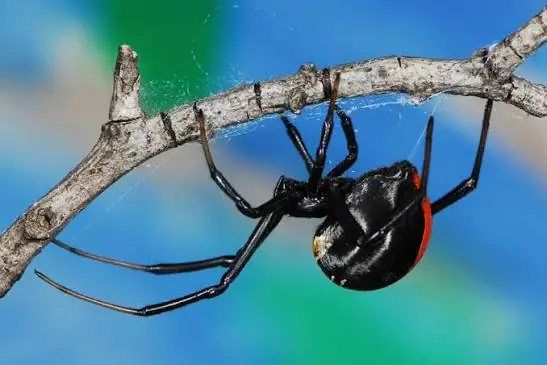
Spider control in Soweto starts with knowing which spiders you have, because most are harmless and a few, like button spiders and sac spiders, can give a nasty bite. We find where they're sheltering, treat those spots and the outside walls with a residual barrier, and help you clear the rubble and clutter that keeps bringing them back.
The spiders that matter
Button spiders
South Africa's widow spiders. The black button spider is shiny black, often with a red mark on the top or underside of its round abdomen. The brown button spider is mottled brown-grey with an orange hourglass underneath. Both make messy, tangled webs in sheltered spots close to the ground. In Soweto yards we find them under stacked bricks and building blocks, inside old tyres, in meter boxes, under garden furniture, in the corners of outside toilets and storerooms, and in the gaps of precast walls. Black button spider bites are serious and need medical attention. Brown button spiders are far more common around homes but much less dangerous.
Sac spiders
Small, pale yellow or beige spiders that hunt at night instead of building webs. They wander across walls and ceilings and shelter during the day in small silk bags in curtain folds, behind pictures or in the corner of a ceiling. They sometimes bite sleeping people, and the bite can turn into a slow-healing sore. If you've woken up with a single painful bite that blistered, a sac spider is a likely cause.
The harmless majority
Rain spiders (the big, flat, brown hunting spiders that come indoors before storms), daddy-long-legs in room corners and garden orb weavers look alarming but aren't a danger. They also eat flies, mosquitoes and other insects, so not every spider needs to go.
Why Soweto yards suit spiders
Building is constant in Soweto: extensions, new rooms, boundary walls, second storeys. That leaves bricks, blocks, sand and timber stacked in the yard for months or years, which is exactly what button spiders like. Insects are another draw. Outside lights over doors and in backyard room passages pull in moths and beetles all summer, and spiders follow the food. And many homes have outbuildings, storerooms and carports that are rarely disturbed, so webs build up quickly.
How we treat spiders
- Inspection. We identify the species and find the shelters: brick piles, tyres, meter boxes, eaves, outbuildings, curtain folds and ceiling corners.
- Webs and egg sacs. We remove visible webs and egg sacs where we can reach them, which takes away the next generation.
- Residual barrier treatment. An odourless, non-staining residual spray along the outside walls, eaves, window frames, door frames and the shelter spots we've found.
- Indoor treatment where needed, for example in bedrooms where sac spiders are active, focusing on corners, behind furniture and the gap where the ceiling meets the wall.
Normal life carries on during and after the visit; the only rule is that children and pets stay off sprayed surfaces until the product has dried.
What people often get wrong
Spraying the spiders they can see and leaving the brick pile, the tyres and the junk in the corner of the yard where the real population is living. The second mistake is reaching into a meter box, a stack of blocks or a pile of old tyres with bare hands. Wear thick gloves, and use a stick to move things first.
A local tip
If building material has to stay in the yard, stack bricks and blocks on pallets away from the house and cover them with a tarp. Move the stack every few weeks so spiders don't settle undisturbed, and never store it against the wall of a room where children sleep.
Spiders in crèches and schools
Places where small children play need a careful approach. Jungle gyms, sandpits with covers, storerooms full of mats and toys, and the underside of outdoor benches are favourite spots for button spiders. At crèches and schools we inspect play equipment and storage closely, remove webs and egg sacs by hand where children's hands go, and keep any residual treatment to walls, eaves and places children don't touch. Visits can be timed for after hours or weekends so the area is dry before children return.
If someone is bitten
Stay calm, keep the person still, and if possible catch or photograph the spider. Get medical help quickly if the bite is from a black button spider or if there's severe pain, cramps, sweating or a spreading sore. Pest control comes after that.
What spider control costs
The price depends on the size of the property, how many outbuildings and backyard rooms are included, and how much shelter there is to treat. A standard house with webs under the eaves is a small job; a big stand with brick stacks, carports and several rooms takes longer. The guide price is on our pest control prices page. If it's just a few harmless house spiders, a broom and a tidy-up may be all you need.
Related pests nearby
The same brick piles that shelter spiders hide scorpions too; see scorpion control in Soweto. Families in Protea Glen, where plenty of homes are being extended, have their own page. Our Soweto pest control page covers the rest. We also treat spiders in Roodepoort and offer spider control throughout Johannesburg.
With 25 years of experience, SAPCA registration and Department of Agriculture registration, Jason van Heerden's team at Combat Pest Control offers service within 24 hours and a 3-month guarantee. Call 084 200 2700, or WhatsApp a photo of the spider so we can identify it first.
Questions we get asked
How much does spider control cost?
It depends on the property size, the number of outbuildings and how much shelter there is. A standard house is a small job; a big yard with brick stacks takes longer. We quote after looking.
Is a black button spider bite dangerous?
Yes, it can be. Get medical help straight away if someone is bitten, especially a child or an older person. Brown button spider bites are much milder.
Will the spray kill spiders that come in later?
Yes. The residual barrier keeps working on the treated surfaces for weeks, and it's covered by our 3-month guarantee.
Is the spider treatment safe for children?
Yes, once dry. Keep children and pets off treated walls and areas until then, and we avoid spraying toys and play areas.
Why do spiders keep coming back to my carport?
Outside lights attract insects, and spiders follow the food. Switching to a yellow bulb or turning the light off when not needed helps.
Should I kill rain spiders?
There's no need. They're harmless to people and eat insects. If they bother you, catch them under a container and release them outside.